Kerala Mural Archive · Space & Ritual
Temple Murals
The sacred enclosure and its painted walls
A Kerala temple is not a building that happens to have paintings on its walls. It is a building whose walls were understood, from the beginning, as surfaces that would be consecrated through painting.
The architectural program of a Kerala temple — the garbhagriha or inner sanctum, the antarala or vestibule, the namaskara mandapa or hall of prayer, the circumambulatory pradakshina path surrounding the sanctum — was designed as a sequence of spatial experiences. The devotee moved through these spaces in a prescribed direction, at a prescribed pace, encountering specific images at specific moments in their movement. The murals were placed within that sequence deliberately.
This is why understanding the spatial logic of the temple is inseparable from understanding the murals painted within it. A figure placed on the southern wall at the height of the chitramaala band was placed there not arbitrarily but according to rules that governed which deity's image appeared on which wall, in which orientation, at which height. Those rules are the grammar of the space. The murals are its sentences.
The Compositional Bands
Five horizontal zones from ceiling to floor
In Kerala temples, the paintings are drawn primarily on the wall surrounding the sanctum sanctorum — the sreekovil. This wall is divided into five horizontal bands, read from the ceiling downward. Each band has a name, a function, and prescribed content.
Bhoothamala
The celestial band · uppermost
The highest band, associated with celestial beings, abstract decorative motifs, and the transition between the human world and the divine realm above.
Pakshimaala
The bird band
A frieze of sacred birds and celestial creatures — the vehicle-beings of the gods, the messengers between worlds — separating the upper celestial zone from the figurative painting below.
Vanamaala
The forest band · decorative
A frieze-like zone with repeated decorative elements — the mashipoov pattern, for instance — giving the wall visual rhythm before the figurative program begins. Similar in function to an architectural frieze in other traditions.
Chitramaala
The image band · primary painting zone
Where the mural paintings proper are drawn. Usually flat, but in some temples extended by architectural projections — panjarams or panjarapadikal — that give painters additional surface and create subtle three-dimensional depth. The chitramaala is the band this archive documents most extensively.
Mrigamaala
The animal band · lowermost
Sacred animals and decorative borders at the base of the wall — the elephant, the lion, the mythological creature — grounding the composition in the earthly world below the divine program above.
Read top to bottom: Bhoothamala → Pakshimaala → Vanamaala → Chitramaala → Mrigamaala
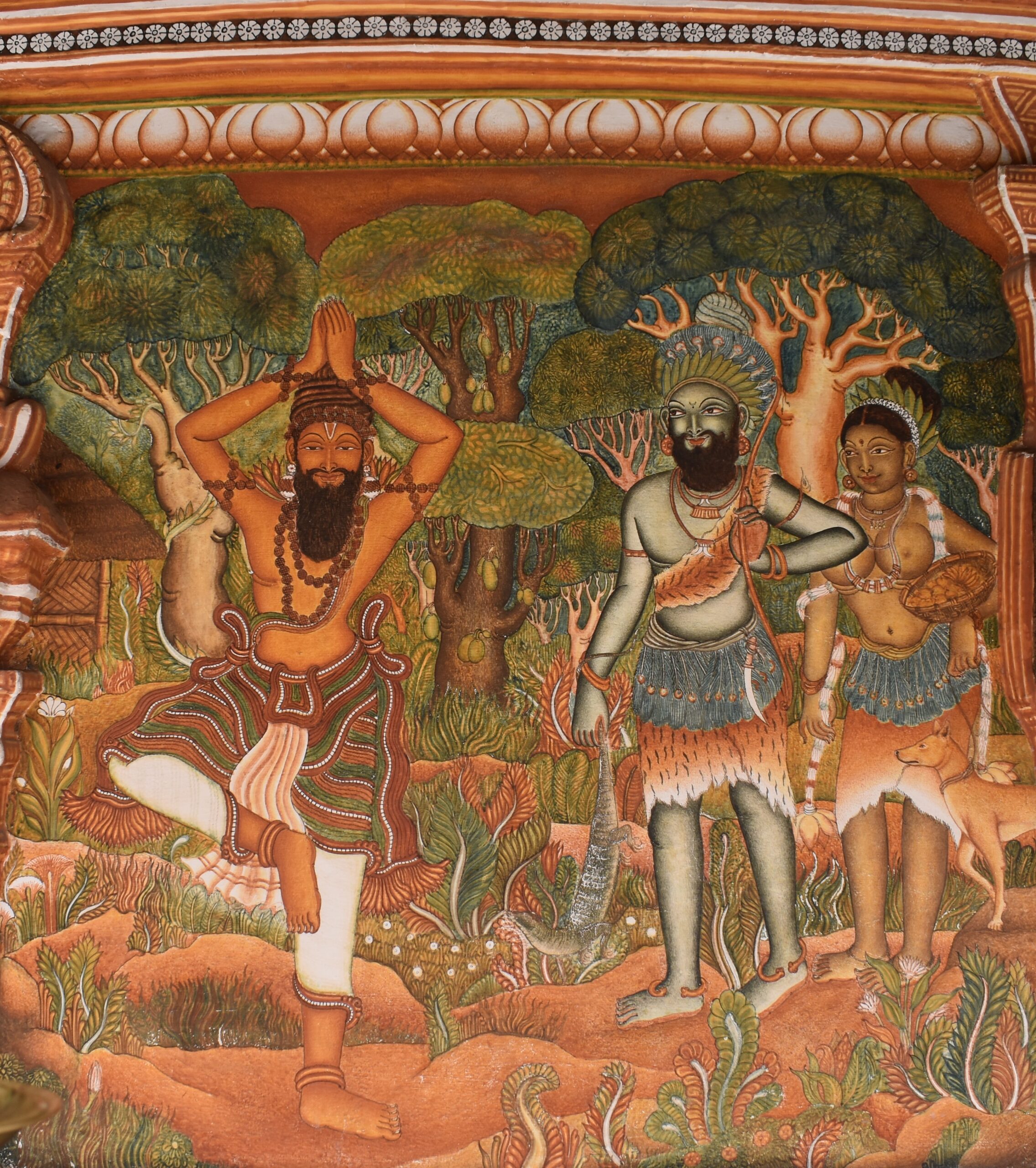
The image of Arjuna, Shiva and Parvathi on the chitramaala band — the primary zone for figurative mural paintings, Thalore Mahadeva Temple.
Rules of Placement
Which wall. Which deity. Which height.
Which deity's stories were painted on which wall was not left to the patron's preference or the painter's discretion. The rules were specified in the ancient treatises — the Tantrasamuchaya, the Silparatna, the Manushyalaya Chandrika — and maintained by the tradition across centuries.
Goddess temple
Tales of the Goddess receive prominence
The Devi's mythological program covers the primary walls. Other deities appear in strictly specified subsidiary positions.
Vishnu temple
Tales of Vishnu and his avatars
The Dashavatara, the Bhagavata stories — arranged according to iconographic hierarchy, with Vishnu holding the central positions.
Shiva temple
Tales of Shiva and his forms
The multiple forms of Shiva — Nataraja, Dakshinamoorthi, Ardhanarishvara — placed according to the orientation that corresponds to each form's identity.
All temples · south wall
Dakshinamoorthi in the upper middle
Dakshinamoorthi — literally "the form facing south" — is always drawn in the upper middle of the southern wall. This is iconographic requirement, not convention.
Between scenes from the same storyline, a decorative pattern resembling a manimaala was used as separation. This same decoration also distinguished gods from humans, asura figures from divine ones, kings from their subjects. The wall's compositional structure encoded hierarchy — not just visually, but theologically.
The painter who violated these rules was not making an aesthetic error. According to the ancient treatises, an imperfect or disproportionate image could not house the deity. In such an image, spirits and ghosts might inhabit instead. A perfect image — one following all prescribed rules — brought prosperity to the artist, the land, and the people. The stakes of the compositional rules were not stylistic. They were metaphysical.
The serene atmosphere of Kadavil Thrikkovil Sreekrishnaswamy Temple, with vocals of sopana sangeetham — the devotional music traditionally sung at Kerala temples.
The Viewing Condition
Painted for lamplight
Temple murals were painted for lamplight. The quality of illumination in a Kerala temple interior — oil lamps casting warm, flickering light from below and from the sides, creating shadows that moved with the flame — was not an environmental accident that painters had to work around. It was the viewing condition they designed for.
Colours that appear almost too warm in flat photographic documentation — the dominant saffron red, the deep yellows — were calibrated for lamplight, which would warm them further and give them a luminous quality that electric light and screen reproduction cannot replicate. The black outlines, drawn last, held each figure together when the rest of the composition was seen in flickering darkness.
The devotee who moved around the pradakshina path encountered different figures as they moved — some catching the lamplight directly, others emerging from shadow. The murals were not static compositions to be viewed from a fixed point. They were a spatial sequence to be moved through, experienced differently at each step.
This archive photographs murals in good controlled light that reveals detail invisible in temple conditions. That is the right approach for documentation. But it produces images that are, in one sense, not quite the murals as they were intended to be seen. The lamp's version of the same wall is irrecoverable.