Researcher's Note
Fieldwork rarely stays within its original boundaries. What began as documentation of temple murals quickly opened into adjacent questions: about the Christian murals of Kerala's churches, about the aesthetic theories that governed what painters could and could not do, about the mineral world that gave these images their colour.
They are not digressions. They are the context without which the murals themselves are harder to read.
Voices & Process
Documentation of a living tradition requires more than photographs of walls. It requires the voices of the people who keep the tradition alive — who mix the pigments, who learn the grammar, who make the daily decisions that determine whether the knowledge survives.
The Painter's Knowledge
What does it mean to work within a tradition that specifies not just what to paint but how to prepare yourself before painting? This conversation with a practising artist explores the lived experience of working within the Kerala mural tradition — the ritual obligations, the technical decisions, the relationship between devotion and craft.
 Watch →
Learning to See
The Kerala mural tradition is now transmitted partly through formal art education. This conversation with a Fine Arts student documents what it means to learn a devotional practice as an academic discipline: the tensions, the discoveries, and what formal training preserves and what it changes.
 Watch →
Making Colour from the Earth
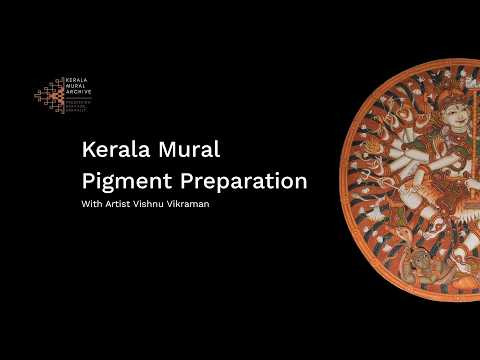
Kerala mural painters traditionally sourced every pigment from the natural world — iron oxide red, mineral yellow, plant green, conch white, lamp soot black. This video documents the preparation of traditional pigments from raw material to the colours you see on temple walls.
 Watch →
Video · Pigment Preparation
Watch →
Video · Pigment Preparation
Preparing the Pigment Yellow
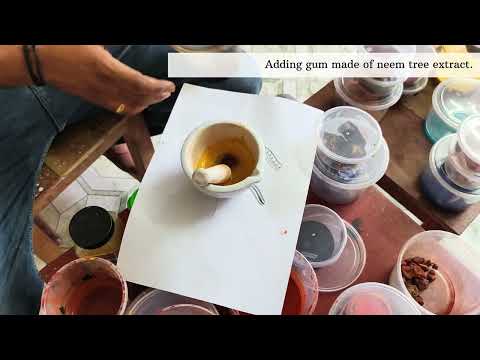
Natural pigments are bound with a gum extracted from neem tree bark before they can be applied to a wall. This clip shows the binder being ground and mixed by hand, a step that determines how the colour will hold once it dries.
Watch → Video · Pigment PreparationPreparing the Pigment Red
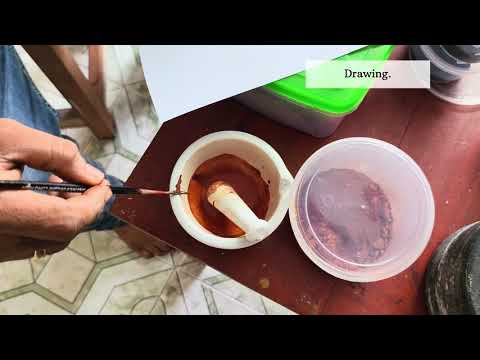
A fine brush carries red pigment onto the surface, laying in the outline the rest of the painting will build on. Red is typically the first colour to touch the wall in the Kerala mural sequence.
Watch → Video · Pigment PreparationPreparing the Pigment Black
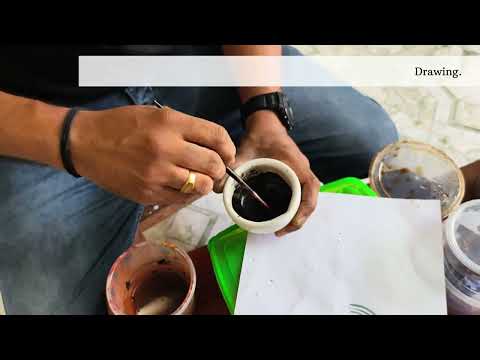
The same drawing process repeats in black, used to define contours and details once the red underdrawing is in place.
Watch → Video · Pigment PreparationPreparing the Pigment Blue/Green
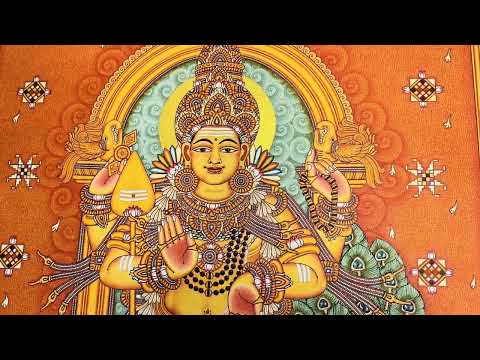
The completed panel, its colours fully built up in layers from the pigments and binders shown in the earlier clips — the result of the process this series documents.
Watch →