Kerala Mural Archive · Origins
History of Kerala Murals
Origins, boom, and survival of a tradition
A tradition over twelve centuries old. Still being painted. Still disappearing.
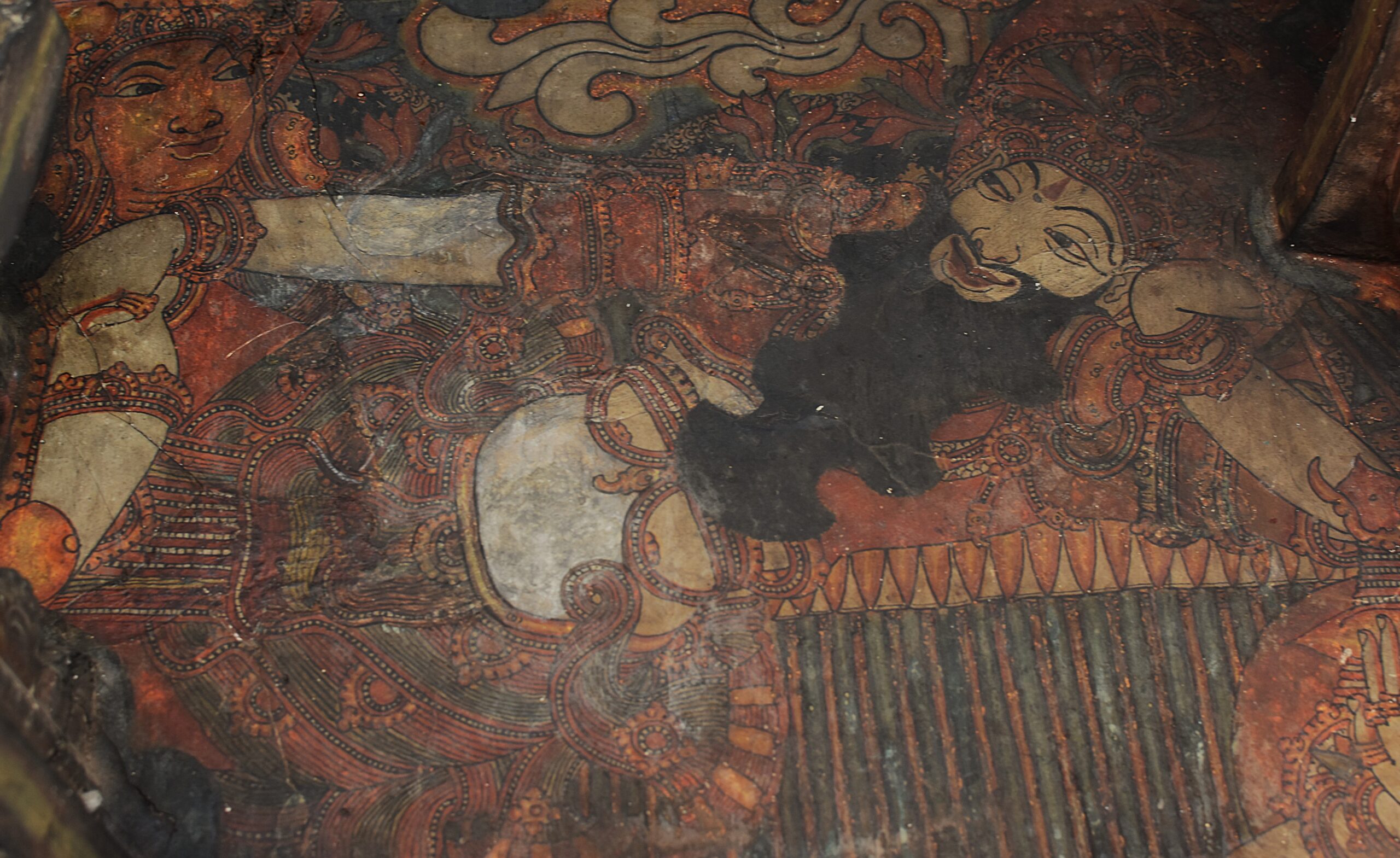
Image of Bheeshma lying on a bed of arrows while Arjuna looks on, from Vadakkunnathan Temple
Before the Walls
A longer history of drawing on surfaces
Kerala's mural tradition did not emerge from nowhere. It grew from a longer history of drawing on surfaces — a history that connects the cave paintings of Bhimbhetka, Ajanta, Vatapi, and Thanjavore to the temple walls of Central Kerala through an unbroken thread of religious and ritual intention.
What distinguished the Indian tradition of wall painting from its earliest period was its purpose. The major themes at cave and early temple sites were drawn from Buddhist and Jainist mythology — images made not as decoration but as vehicles for devotion. Kerala mural paintings carried this same fundamental intention forward: they were not meant as attractive ornamentations but as a means to generate bhakti — devotion — in the minds of those who stood before them.
Before the structural temples that came to house Kerala's mural tradition, the Dravidian Kalamezhuthu tradition was prominent in the region — coloured powders used to draw temporary images of deities on the ground. With the shift from cave temples to structural temples in the eighth and ninth centuries, driven by Aryan cultural influence, the temporary image on the floor gave way to the permanent image on the wall. The devotional intention remained the same.
The Earliest Sites
The ninth century and the tradition's origins
The mural paintings of Kerala have their origins traced back to the Thirunanthikkara murals, estimated to have been composed during the ninth century. These, and the sites that followed — Kanthaloor, Thrivikramamangalam, Parthivapuram, Ananthapuram in Kasargode, and the cave temple of Chitral — represent the earliest surviving evidence of the tradition.
From the beginning, Kerala mural painting did not follow realism. Idealised, imaginative depictions were the standard — figures drawn according to the thala system employed in sculpture, using precise proportional measurements derived from Sanskrit art treatises. The painter worked not from observation of the world but from the dhyana sloka — the Sanskrit verse describing the deity — held in the mind during composition.
Primary textual sources: Chitrasoothram, a part of the larger Vishnudharmottarapurana, and Chitralakshana, a chapter in Shilparatnam by Srikumara — specifying not only iconographic requirements but the moral and ritual obligations of the painter.
The Classical Boom — 15th to 18th Century
Five centuries of the tradition's history
Origins
The earliest surviving mural sites date to this period — the tradition already mature, suggesting origins earlier still. Cave temples give way to structural temples. The first walls receive permanent painted images.
The grammar is established
The tradition consolidates its visual grammar under the Kulashekhara Perumals and their successors. The five-colour system, iconographic typologies, and compositional conventions become the standard. Temple construction expands; mural painting expands with it.
Zenith
The paintings were at their most abundant and accomplished during this period, driven by the rise of the Bhakti movement in Kerala. The major patronage networks — the Zamorin of Calicut, the Raja of Cochin, the rulers of Travancore — produced the most ambitious mural programmes Kerala has seen: Mattancherry, Vadakkunnatha, Thiruvanchikkulam.
Colonial contraction
The collapse of temple-related socio-cultural life began with the attack of Tipu Sultan and the subsequent British invasion. European painting styles dominated Indian traditional styles; the popularity of Raja Ravi Varma led many artists to abandon the Kerala mural tradition in favour of his naturalistic style.
Documentation and crisis
The fire at Guruvayur temple in the 1970s destroyed the murals there and prompted a reassessment of what was being lost. A centre was established in Guruvayur in 1989. Mural camps organised by the Southzone Cultural Centre followed in 1990. Four formal teaching institutions now exist.
What Was Painted and Where
Rules that were precise and non-negotiable
The rules governing which paintings appeared in which locations were precise. In a Goddess temple, tales of the Goddess received prominence. In a Vishnu temple, tales of Vishnu. Other gods could appear in strictly specified positions — the Dakshinamoorthi image is always drawn in the upper middle of the Southern wall.
The wall surrounding the sanctum sanctorum was divided into five horizontal bands from the ceiling. The murals were drawn at the chitramaala portion — the central band.
Between scenes from the same storyline, a decorative pattern resembling a manimaala was used as separation — also serving to distinguish gods from humans, asura figures, or kings from their subjects. The primary themes drawn from Hindu mythology:
The Artists
Mostly unknown. A few named.
Most of the artists who painted Kerala's murals are unknown. The tradition of associating art with the artist began only towards the end of the seventeenth century. A few inscribed their names alongside their creations. Most did not.
The artists belonged predominantly to elite communities — Tamil Brahmins, Kerala Namboothiris, Ambalavasis, and members of the Nair community. They were trained under the gurukula system — a student accompanying a guru through years of apprenticeship before working independently.
Thiruvananthapuram Narayanapattar
Among the few named artists recoverable from later periods
Guruvayoor Chinnathambi Appupattar
Named artist from the tradition's later period
Nenmini Namboothiri
Named artist from the tradition's later period
Raman Nair and disciples
Painted the murals around the sanctum sanctorum of Guruvayur temple. After the 1970s fire, responsible for redrawing the lost works — establishing the Guruvayoor style.
An inscription at the Udayampeeroor Perumthrikkovil temple — dating murals to 957 AD — records something remarkable: that even Ezhavas and Valanmar, communities who had no right to temple entry at that time, commissioned these murals. Sasibhooshan suggests this was a consequence of political conditions during Mysore's conquest under Hyder Ali, which had prompted unlikely unity among communities facing a common threat.
The Map of Sites
A pilgrimage through the mural tradition
This archive documents sites primarily within Ernakulam and Thrissur districts of Central Kerala. Each point on the map corresponds to a documented site in the archive.
The Tradition Now
The Kerala mural tradition is alive. It is also fragile in ways it has never been before. Second-generation mural artists are increasingly utilising online spaces to disseminate their work — social media, e-commerce sites, YouTube. The murals appear in new contexts: as decorative pieces, as part of textiles, adorning the interiors of hotels and commercial spaces.
The walls that carry the tradition's oldest and most significant examples are deteriorating. The knowledge required to make new walls in the traditional manner is held by a small community of living practitioners. The texts that governed the tradition — Chitrasoothram, Chitralakshana, the Tantrasamuchaya — have been translated and published, but reading them is not the same as learning from a guru.
This archive documents what exists. It cannot stop what is being lost. But it makes the case, by the simple act of careful documentation, that what exists is worth the effort of preservation.