Kerala Mural Archive · Origins
The Living Tradition
Kerala mural painting today — and tomorrow
The tradition did not end. But it changed — and it is still changing.
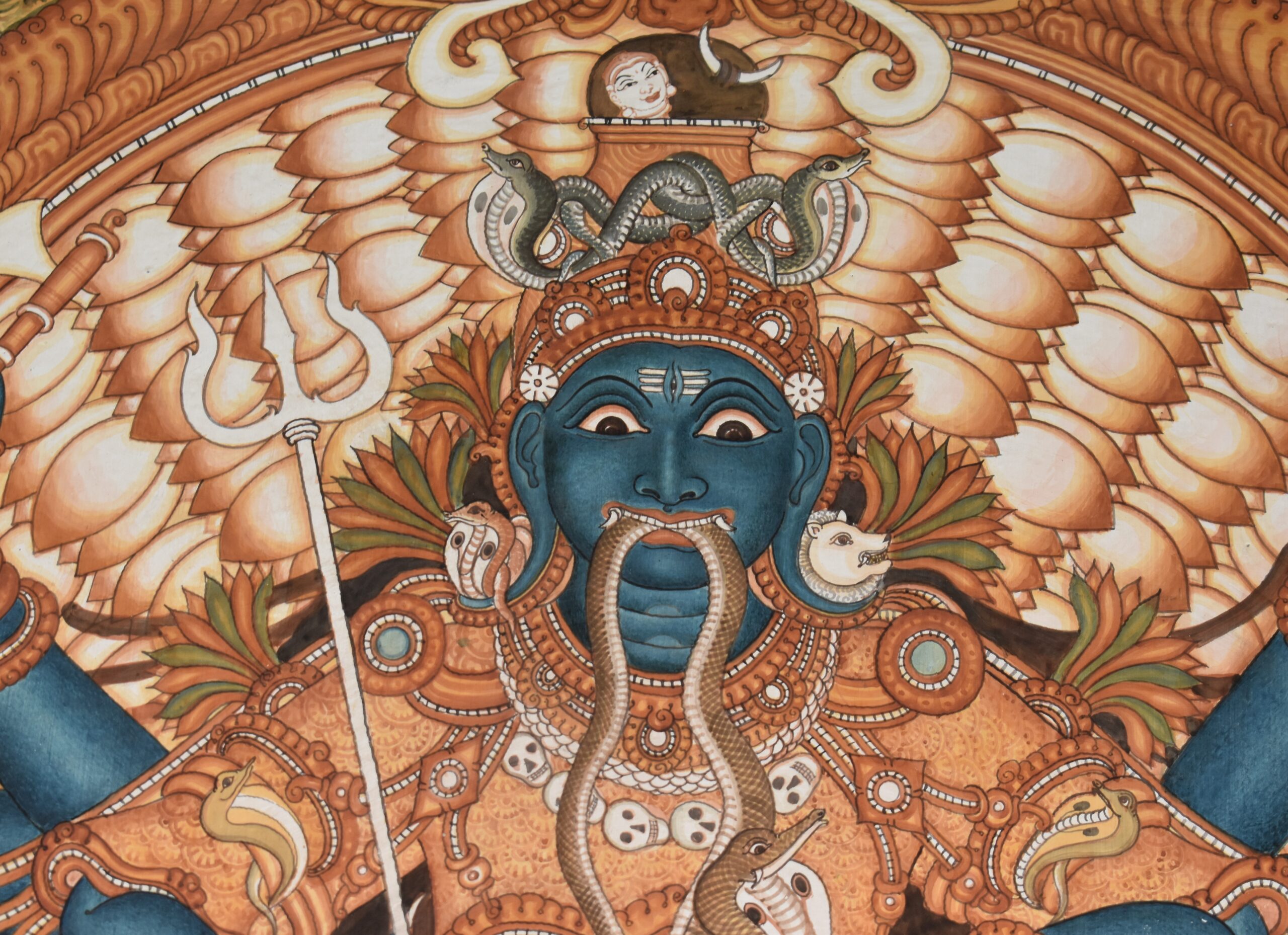
Aghoramoorthi panel, Thalore Mahadeva Temple.
A tradition survives when it is practised. Not when it is documented, not when it is studied, not when it is archived — though all of these matter — but when someone picks up a brush, recites the dhyana sloka, and draws the line on the wall.
By that measure, Kerala's mural tradition is alive. New murals are being commissioned. New painters are being trained. The knowledge of how to prepare lime plaster, grind organic pigments, and draw according to the thala system exists in living human beings and is being passed on.
But survival is not the same as security. The conditions that sustained the tradition for a thousand years — the gurukula transmission system, the network of royal patronage, the temple walls built from materials that accepted lime-based paint — have changed substantially. What the tradition is surviving into is a world that requires constant negotiation between the old forms and new circumstances.
How the Tradition is Transmitted Now
From gurukula to institution
For centuries, Kerala mural painting was transmitted through the gurukula system. A student lived with and studied under a guru, learning not just technique but the devotional and ritual framework within which technique was embedded — how to prepare pigments and brushes, the dhyana slokas to be memorised, the figures practised by drawing and redrawing until the patterns became imprinted in the mind.
The gurukula system
Institutional training
What formal education preserves and what it inevitably changes is a genuine question. The gurukula system transmitted the tradition as a lived practice — devotional, embodied, relational. Institutional training transmits it as a discipline. Both are real forms of transmission. They produce different kinds of painters.
Four Centres of Instruction
Where the tradition is taught today
01
Guruvayur Devaswom Mural Institute
Established in 1989 under the Devaswom administration, in direct response to the temple fire of the 1970s that destroyed the existing mural program. The most direct institutional response to a specific crisis of loss.
02
Ernakulam Ravipuram Indian School of Arts
Based in Ernakulam, serving the geographic heartland of the mural tradition in Central Kerala — a region dense with the active temple and palace sites where the tradition was practised.
03
Kalady Sree Sankaracharya University
Situated at Kalady — the birthplace of Adi Shankaracharya — bringing the tradition into formal university education and connecting it to the broader history of Kerala's philosophical and spiritual life.
04
Aranmula Vasthuvidya Kendra
At Aranmula, connecting mural training to the broader tradition of Kerala's traditional architecture and craft knowledge — recognising that the tradition cannot be separated from the walls that receive it.
New Contexts, New Walls
Where the murals appear today
The initially temple and palace-bound tradition has expanded into new contexts. Second-generation artists are utilising online spaces — social media, e-commerce, YouTube — to disseminate and sell their work. G. Azheekode, in his work Chuvarchitrakala: Oru Sankethika Padanam, noted the emergence of female artists in the modern period, a significant departure from the historical pattern in which the tradition was transmitted almost exclusively through male lineages.
Commercial
Hotels & hospitality spaces
Commissioned works in hotel lobbies, restaurants, and resorts — the tradition's widest new audience.
Domestic
Private homes
Smaller-format works for residential collectors, often produced on canvas rather than plaster.
Applied
Textile and product design
Mural motifs adapted into fabric prints, jewellery, and artisanal products — the tradition's most diffuse form.
This expansion has brought Kerala mural painting to audiences who would never have encountered it in its original ritual context. It has also introduced what Sasibhooshan and others have noted as a process of commodification: murals increasingly produced for aesthetic or commercial value rather than devotional purpose. Whether what is carried forward in these new contexts is the tradition or only its visual surface is an open question.
The Architectural Problem
A tradition needs the right walls
The most structurally threatening challenge facing the living tradition is one that receives less attention than deterioration or declining patronage: the disappearance of the surfaces on which the tradition depends.
Kerala mural painting requires lime plaster walls — specific walls, built in specific ways, using specific natural materials. New temple construction increasingly uses cement and modern building materials that cannot support lime-based paint in the traditional manner. Renovation projects replaster walls that carried centuries of painting — sometimes destroying what existed to install a surface that cannot receive what would replace it.
A tradition of wall painting needs walls. The right kind of walls are becoming rarer. This is not a problem that documentation can solve, or that institutional training can address. It requires decisions by temple authorities, architects, and construction professionals about how new and renovated temple buildings are made — decisions happening now, without the tradition's interests necessarily at the table.
Some temples are making those decisions consciously — commissioning new mural work on traditionally prepared lime plaster surfaces, maintaining the material conditions the tradition requires. These sites, and the relationships that make them possible, are among the most important things the tradition has going for it.
This archive was built from the conviction that documentation is not preservation — but that it is a necessary condition for the kind of attention preservation requires.
The Kerala Mural Archive documents what exists: the paintings on the walls, their sites, their iconographic content, their conservation status. In doing so, it also documents — by implication — what is at risk. Every mural entry with a conservation status of deteriorating or damaged is an argument for intervention. Every site documented is a site whose existence is now on record.
The living tradition does not live in this archive. It lives in the hands and minds of the painters who continue to practise it, in the walls that receive their work, in the temple spaces where the murals are seen in the light they were made for.
What the Archive Does
What the archive does is make the tradition visible — to researchers, to students, to policymakers, to anyone who did not already know it existed and now might care about whether it continues.
That is a modest contribution. It is also a real one.