Kerala Mural Archive · Conservation Essay
What is Lost,
What Remains
The Deterioration and Survival of Kerala Murals
The murals in Kerala are in different states of deterioration. This is not an abstract statement about antiquity and time. It is a fact about specific walls, specific faces, specific colours — things that existed when the painter drew the unmeelanam and will not exist in their current form much longer.
This archive was built because of that fact. This essay tries to be honest about what it means.
What Causes Deterioration
Climate, human damage, and well-meant conservation
Kerala's tropical climate is the primary agent. The combination of humidity, monsoon rainfall, and temperature fluctuation works against lime plaster in ways that are difficult to arrest. Fungal and microbial infections damage the pigment surface. Soot from lamps lit during daily worship darkens and obscures the paintings over time.
Humidity & monsoon
High moisture levels cause lime plaster to weaken and pigment to lift. Temperature fluctuation accelerates the process year-round.
Fungal & microbial growth
Organic pigments are vulnerable to infection. Soot from devotional lamps accumulates over decades, obscuring surface detail.
Contact & alteration
Devotees smearing sandalwood paste, scraping paint, drawing additions. Wiring installed through painted surfaces. Deliberate defacement is not isolated.
Synthetic retouching
Synthetic pigments used to retouch original organic ones — a replacement regarded as more damaging than deterioration itself, because it is irreversible.
The murals at Thirunandikkara — one of the oldest mural sites in Kerala — have deteriorated completely, despite being a protected monument. Protection in name does not always translate to protection in practice.
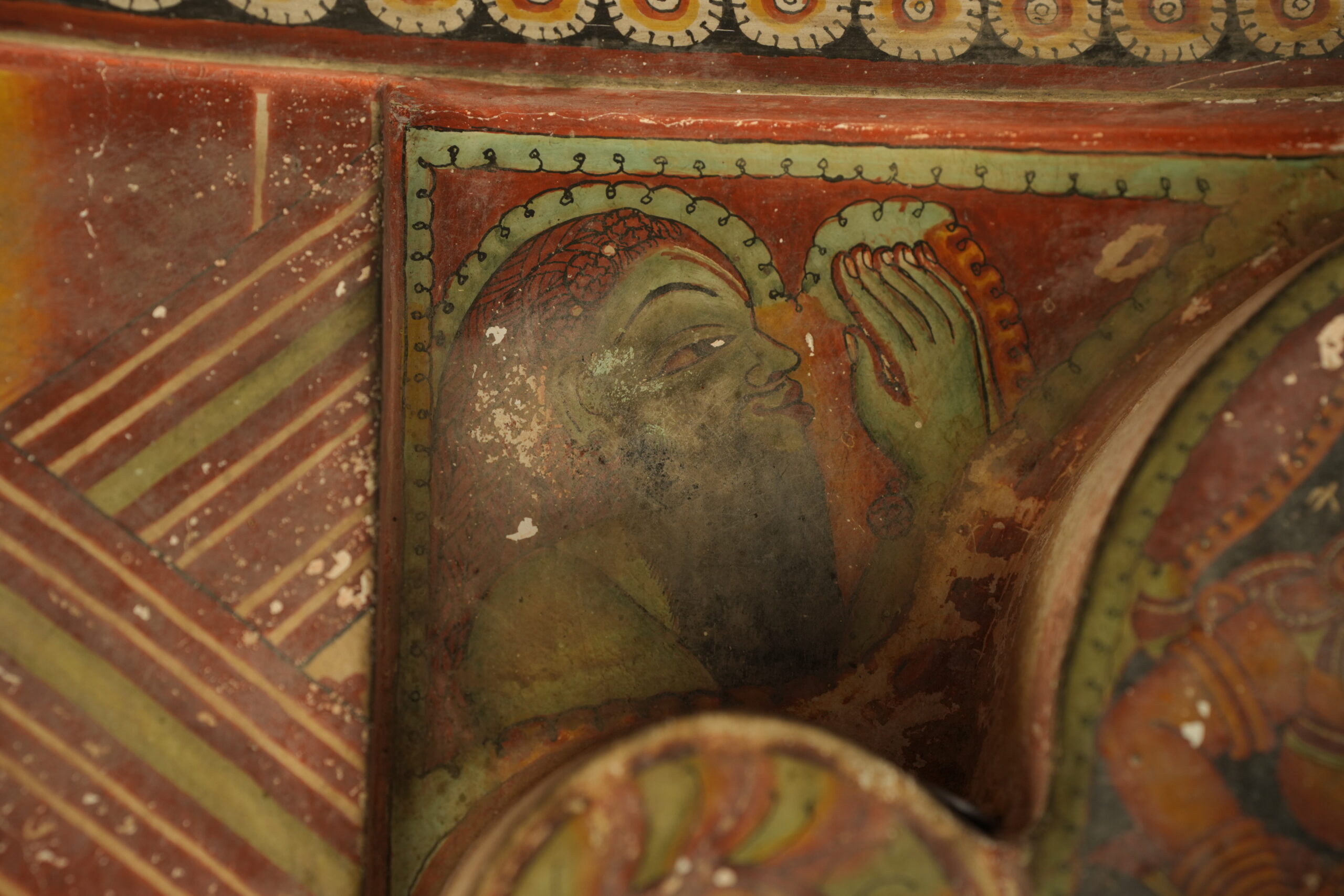
Documentation of surface deterioration possibly due to fungal attack at Kadavil Thrikkovil SreeKrishnaswamy Temple.
What Conservation Looks Like
A careful, underfunded process
Conservation work on Kerala murals follows a sequence of interventions. Each step requires specialist skill and material; very few efforts have been made at scale.
Surface cleaning
Cotton swabs are used to remove dirt, dust, and accumulated soot. The process also addresses, to some extent, oil stains and early-stage microbial damage.
Stabilising flaking paint
Where paint has begun to chip or lift, a consolidant solution is applied to the surface to prevent further loss before the paint detaches entirely.
Final consolidation
A mixture of PVA (polyvinyl acetate) and toluene is applied across the treated area as a final protective layer to bind and seal the surface.
Structural repair
Where walls have begun to collapse or crack, a mixture of plaster and white cement is used to arrest further structural deterioration.
The broader structural challenge is that it is impractical for the government to declare all temples with murals as protected monuments. Most scholars agree that steps must nevertheless be taken — but what those steps are, who funds them, and who has the authority to implement them remains unresolved.
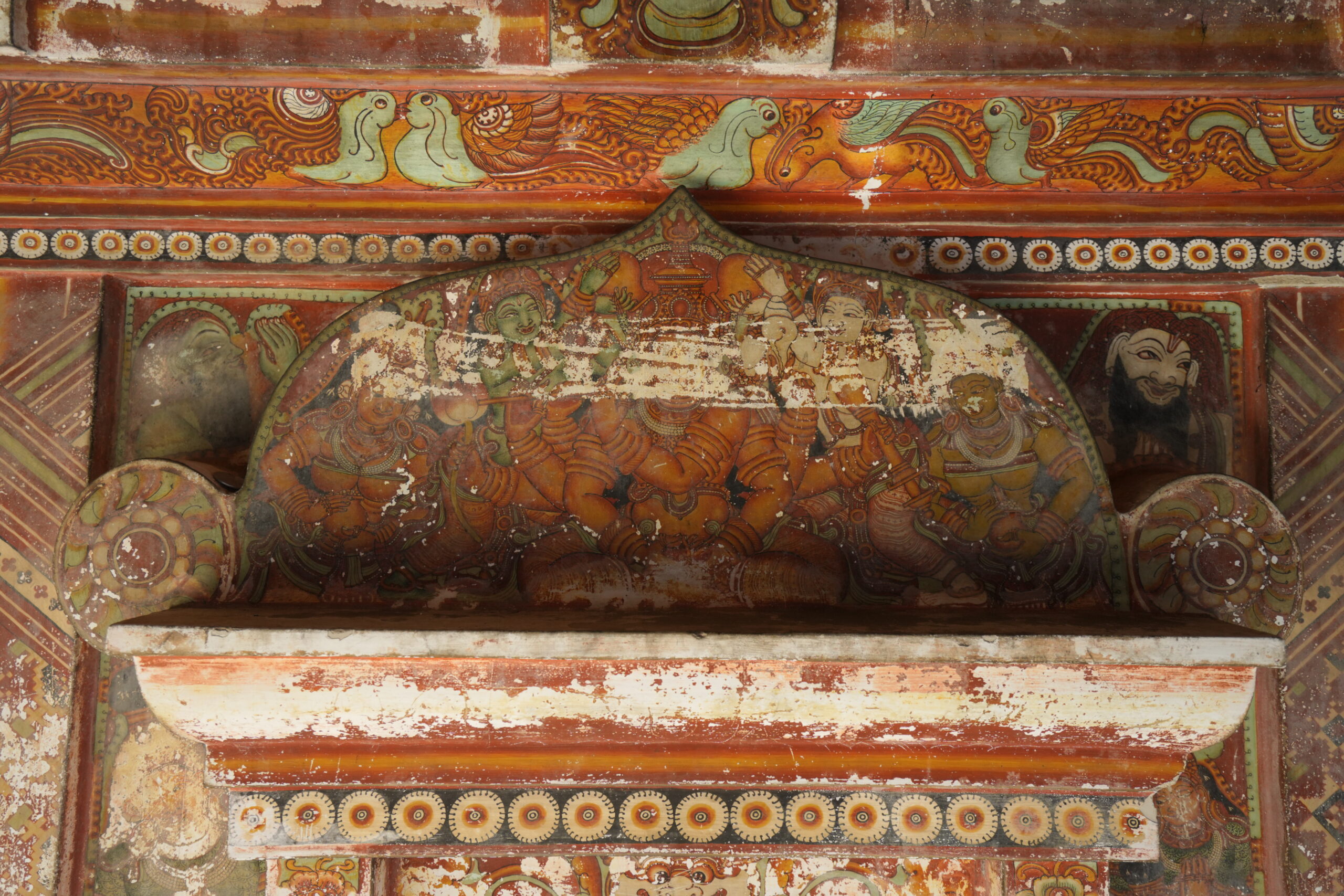
Damage caused by vandalism at Kadavil Thrikkovil Sree krishnaswamy Temple.
What Digital Documentation Does and Does Not Do
A record, not a rescue
A digital archive preserves what is visible at the moment of documentation. It does not stop the deterioration. It does not restore what has already been lost.
What this archive does is create a record — a high-resolution, metadata-rich, searchable record — of what existed at a specific point in time. Documentation is not conservation. But it is a foundation that makes informed conservation possible, and it preserves something essential even when conservation fails.
The Tradition that Survives
The knowledge, not only the paint
What is fragile is not only the paint on the walls. It is the knowledge of how to make the paint, how to prepare the wall, how to recite the dhyana sloka, how to draw the unmeelanam — the entire embodied tradition of practice that took centuries to develop and is now transmitted by a small community of living painters.
Four main centres now exist for formal instruction:
What formal education preserves and what it changes is one of the central questions this archive's video interviews explore. New murals are being commissioned. New artists are being trained. The tradition is alive.
It is also in a condition that requires attention — from researchers, from temple authorities, from the state, from anyone who believes that what these walls contain is worth the effort of preservation. This archive is one part of that effort. It is not sufficient. But it is a beginning.
Explore the archive, hear from the practitioners, and learn more about the research behind this documentation project.