Kerala Mural Archive · Technique & Craft
Before the Line
The painter's preparation — ritual, material, and method
Before the first mark was made on the wall, the painter had already done most of the work. Not the physical work — not the grinding of pigments, not the layering of lime plaster, though those were extensive. The inner work. The ritual preparation that determined whether the line, once drawn, would carry life or remain inert.
The Ritual Before Painting
Meditation, dhyana sloka, and beginning
After deciding on the figures to be drawn, an auspicious day was chosen for commencement. Prior to beginning, blessings of god and guru were sought. Sometimes puja was performed on the brushes themselves. The artist would meditate, recite the dhyana sloka of the deity they were about to draw, bring the deity to mind completely, and only then begin — facing east.
This was not ceremony for its own sake. It was theological preparation for an act understood as invocation. The quality of the painter's inner state was held to determine the quality of the deity's presence within the finished work.
The art was taught under the gurukula system for centuries. Students learned the dhyana slokas, pigment preparation, and composition rules under a master — practicing by drawing and redrawing plants, animals, and figures on floors and wooden planks using stones, charcoal, or plant stems until the patterns became imprinted in the mind. They then accompanied the guru on commissions, learning the devotional practice within which technique was embedded.
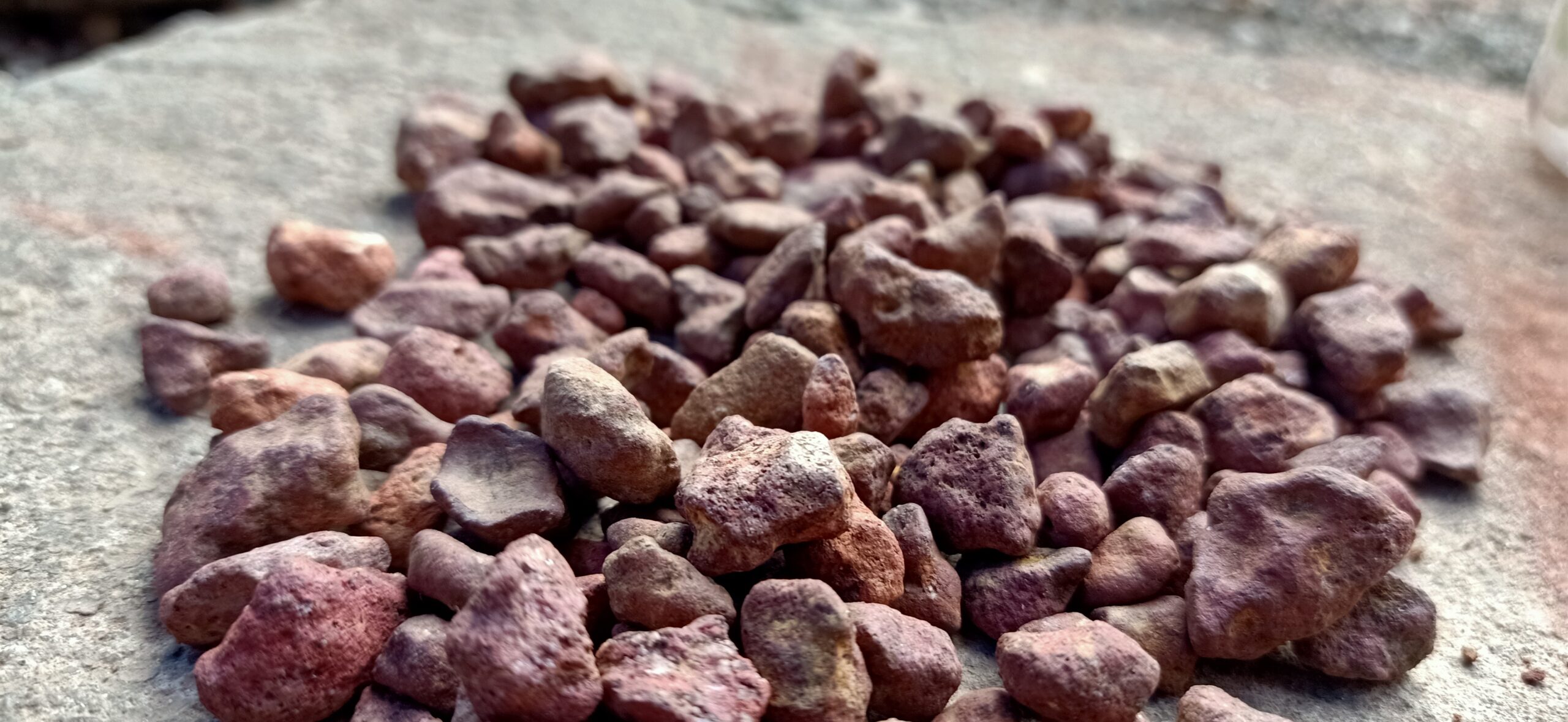
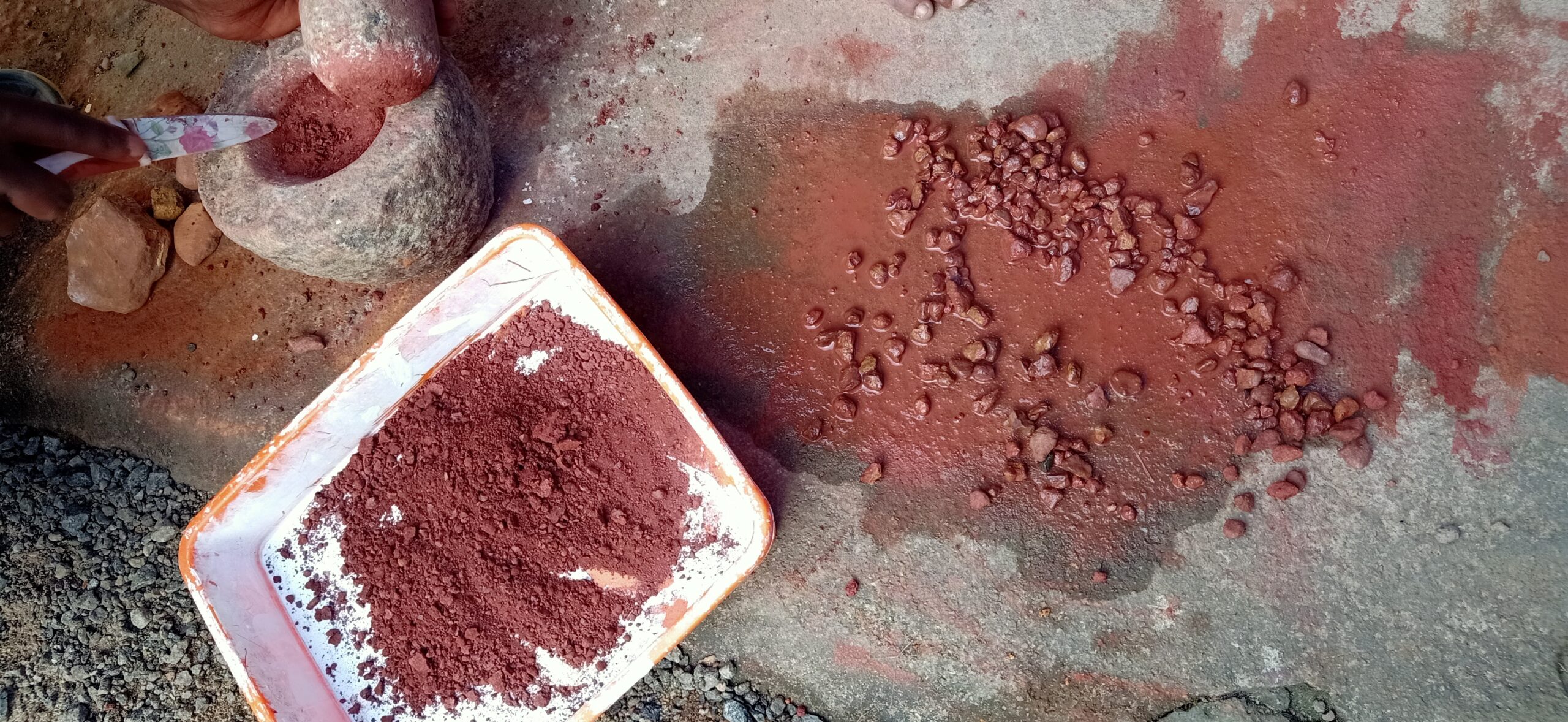
Preparation of red pigment, Fieldwork documentation.
Preparing the Wall
A prepared substance, not a neutral support
The wall itself required elaborate preparation before a mark could be made. Natural adhesives prevented the lime plaster from peeling off the laterite substrate: neem tree extract, kallippal, vilampasha, jaggery.
Primary lime plaster
Sand and lime finely sieved, ground, mixed with water, kept aside for at least two weeks. Gum extracted from uzhinjalvalli or poolamaram then incorporated.
Secondary smooth layer
A finer lime layer applied over the primary surface. Finely sieved lime mixed with jaggery solution and water, applied over the base once cured.
Drawing surface
Multiple layers of slaked lime, tender coconut water, and cow milk applied to create the final smooth drawing surface — the prepared ground that would receive the pigments.
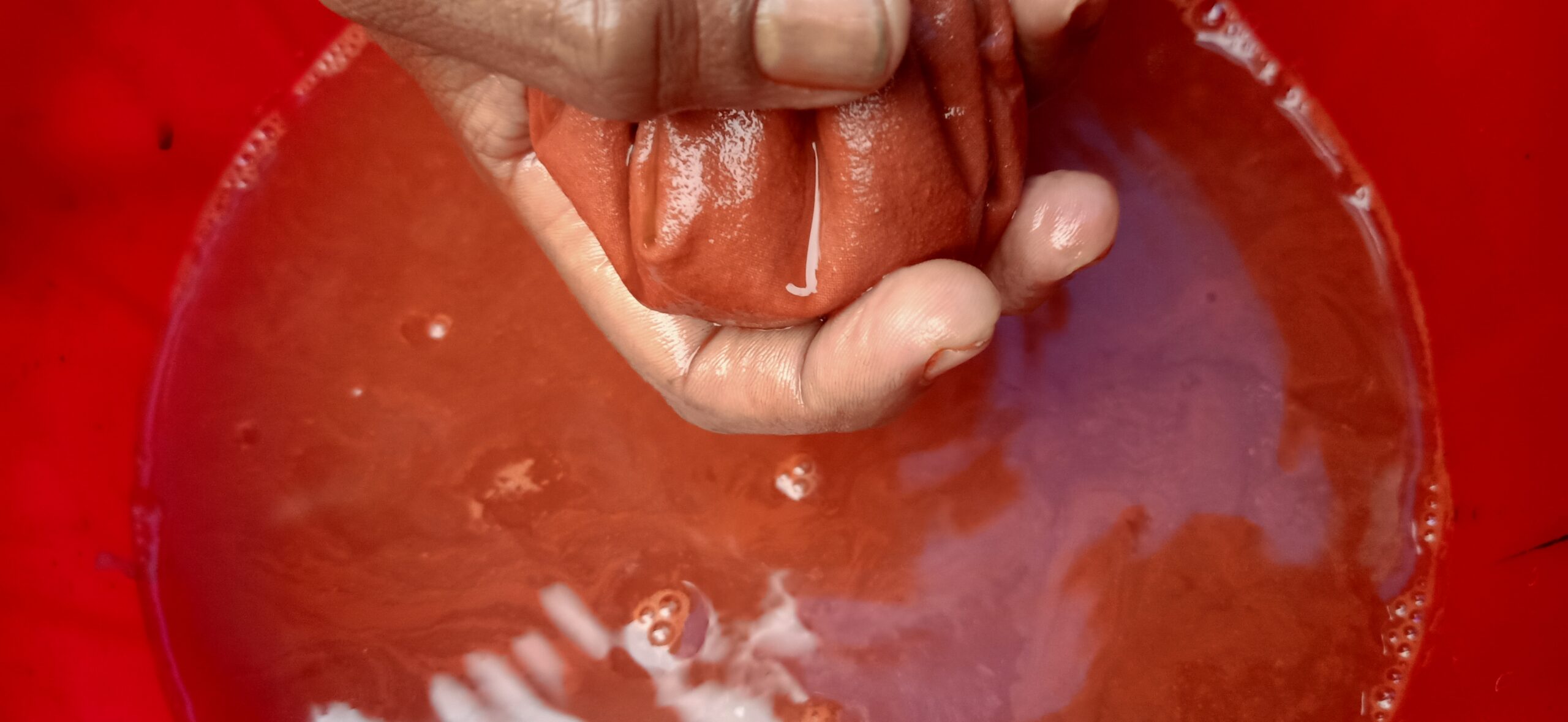
Wall preparation detail. Fieldwork documentation.
Preparing the Pigments
Five colours. All from the natural world.
Only five colours were used in ancient Kerala murals: yellow, red, green, white, and black. The murals have survived over centuries partly because the painters used pigments that did not react with lime plaster. Every pigment was sourced from nature.
Each pigment required patient preparation: laterite stones were washed in pure water, then ground slowly on an arakallu into a fine paste, transferred to a vessel, mixed with water, left to settle, filtered of sediment — the process repeated as often as needed to obtain a transparent, pure pigment. The final paste was poured onto a clay vessel and dried in shade. Pigments were prepared in wooden utensils and transferred to empty coconut shells while drawing.
Black came from a poetic source: oil soot collected from the very lamps burning in the temples where the painters worked.
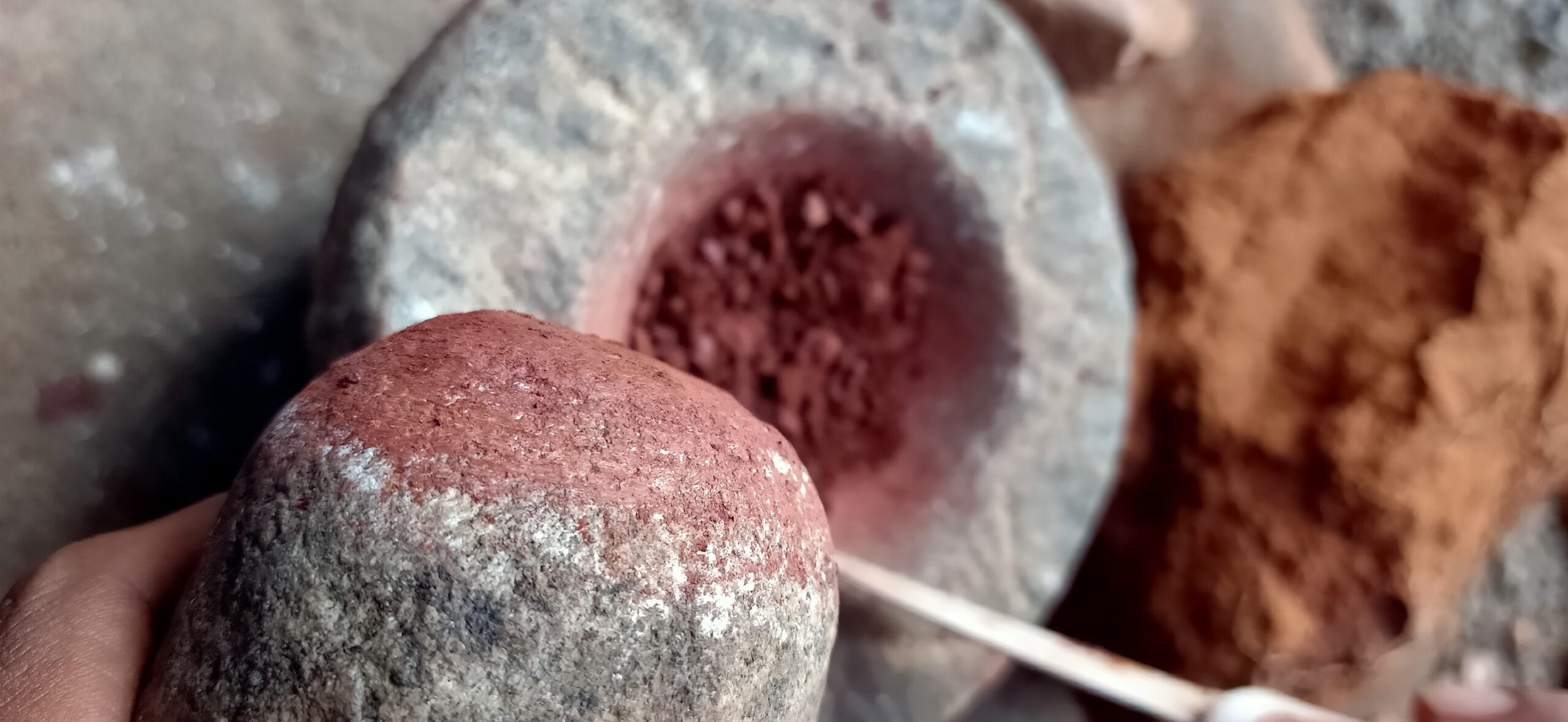
Pigment preparation. Fieldwork documentation.
Watch the Process
This page describes pigment preparation in words. A five-part video series shows it directly — grinding, binding, and laying in each colour by hand. Watch the pigment preparation videos →
The Composition Sequence
A precise order of making
The composition followed a fixed sequence. Each stage built on the last, and the order was not arbitrary — it reflected both the technical requirements of lime fresco and the theological logic of the tradition.
Initial lines — kittalekhani
A chalk-like instrument prepared from old bricks or mud nests of a wasp mixed with dried cow dung was used to draw the preliminary composition lines on the prepared wall surface.
Tracing in yellow
The initial lines were then traced using madhyamalekhani dipped in yellow paint, establishing the forms more precisely before colour was applied.
Correction in red
The lines were made sharper and errors corrected using red pigment — refining the drawing before areas were filled.
Filling — in order
Nutgrass brushes filled in the areas; broader areas used a kaithaveru brush. The order was fixed: ornaments first, then body, then clothes, then background.
Shading — varthana
Colours were absorbed by the wall rapidly, so each shade required multiple applications to achieve depth. This repeated shading process was called varthana, and came in three distinct methods.
Black outline — mashiyezhuthuka
The defining black outline was the last act, not the first — the reversal of how most painting traditions operate. Only when all colour and form was complete did the painter draw the line that closed each figure.
The Three Types of Shading
The varthana technique — the repeated application of pigment to build depth — came in three distinct forms:
Type I
Pathrakam
Lines resembling leaf veins applied across the surface — following the natural branching patterns of organic forms.
Type II
Rekhikam
Narrow parallel lines drawn in the same direction across the area — a systematic, directional shading method.
Type III
Bindujavarthana
Dots used for shading — considered the most suitable technique for wall surfaces, and the most demanding in execution.
The Final Act
The composition ends with the black outline. The colours and forms were built up in layers, and only when everything was complete did the painter draw the defining line that closed each figure.
And then, before the work was truly finished, came the unmeelanam ceremony — the filling of the pupils of the most important figures in the mural. It was believed that after this process, the image came alive.
The ceremony was performed before a lighted lamp, sometimes after camphor worship, on an auspicious occasion. In temples, it was accompanied by prayers and the sounds of conch shells. The patron would hand the brush to the artist, requesting them to carry out the unmeelanam. The artist, having prepared the wall, prepared the pigments, meditated on the deity, drawn the form in its entirety — now drew the eyes.
And the god looked back.