Kerala Mural Archive · Visual Essay
Kerala's Church Murals
Where the Word became image — and two worlds met on a wall
The Christian church murals have incidents from the Old and New Testaments as prominent depictions. The monograph by Dr Jenee Peter and P K Gopi titled Church Mural Art of Kerala (2009) discusses the peculiarities of the ancient mural paintings found in the churches of Kerala. They establish these as an integral part of the history of Kerala Christianity and highlight the need to preserve the same.
Origin
After the Synod of Udayamperoor, 1599
The murals on churches boast of a history of at least four centuries. It was after the 1599 Udayamperoor Synod that the significance of drawing murals on church walls was recognized. This single ecclesiastical council — convened near Kochi — set in motion an extraordinary visual tradition that continues to survive on those walls today.
They assert that the murals in churches were didactic in purpose and did not have a ritualistic base. Furthermore, they highlighted how these followed different rules of composition than the temple murals. These murals were painted on the Madbaha of the churches and sometimes on thora.
A Confluence of Traditions
Central Asian Christian art meets Kerala's mural tradition
The resulting murals combine Central Asian Christian art style and traditional Kerala mural painting style. The artists adopted the same techniques as traditional Hindu mural artists in preparing the walls and pigments. This shared craft knowledge — passed between communities across confessional lines — is the invisible foundation of these paintings.
Material Culture · The Blue Pigment
Lapis lazuli from Afghanistan
The only exception is the use of Lapis lazuli from Afghanistan for blue pigment that may be brought to India by priests visiting from Damascus. A single material traces a journey from the mines of the Hindu Kush, through Damascus, to the walls of Kerala's ancient churches — carried by priests, not merchants.
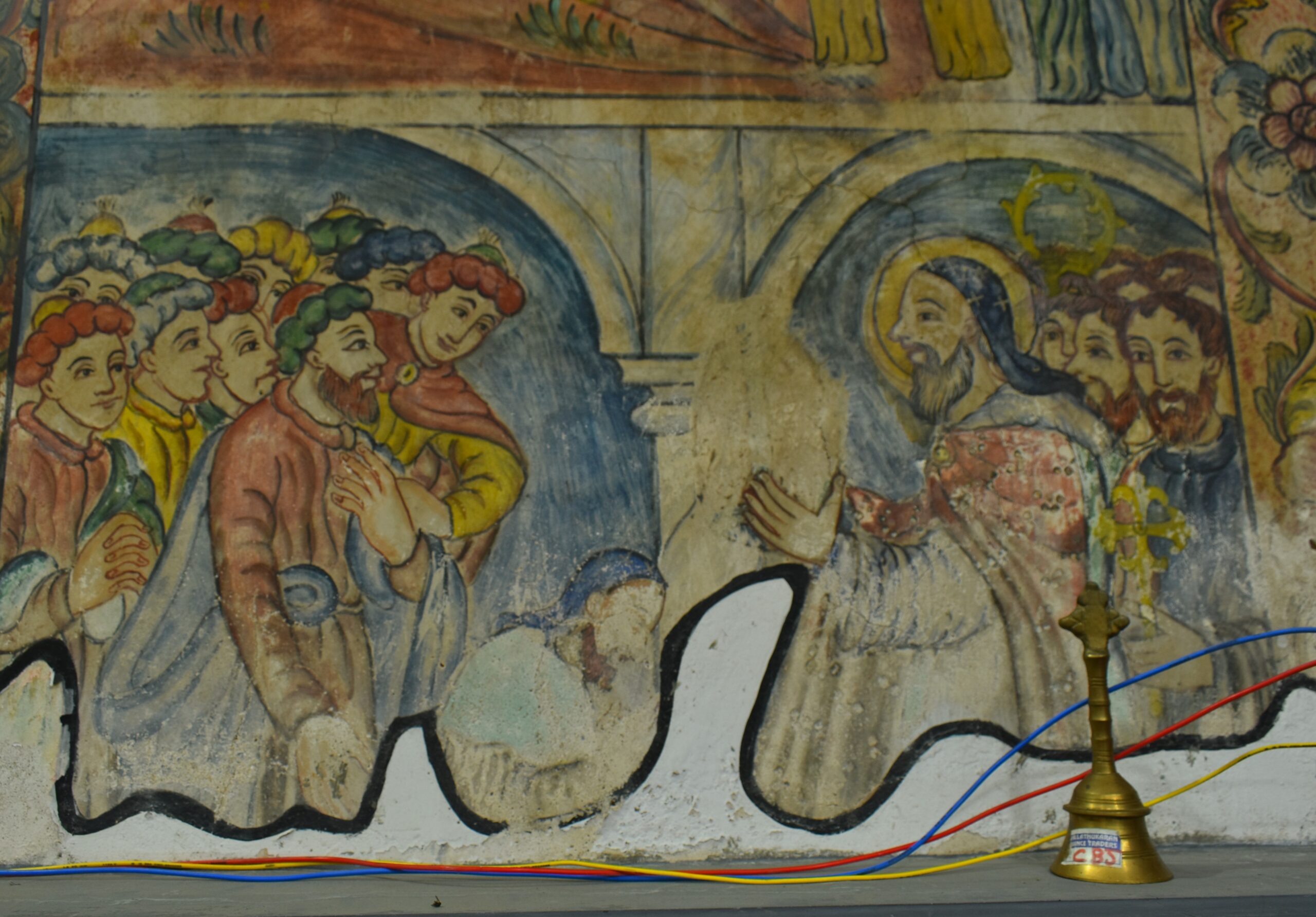
Detail — the distinctive blues of lapis lazuli, traceable to Afghan mines
Stylistic Distinctions
A different grammar of form
The church murals did not follow the thala system used in the temple murals — the precise iconometric proportions governing the human figure in Hindu visual tradition. The departure was total, and visible:
Temple murals
Church murals
Furthermore, the Church murals were more colourful compared to the temple murals. Also, the former's depictions were more realistic. The depictions mainly possess a childlike simplicity, resembling child art. There is also an absence of decorative lines surrounding the figures.
Significant Sites
Churches bearing significant murals
Composed post-16th century, some significant murals can be found in churches such as:
The mural tradition of Kerala's churches was not merely artistic — it was a form of cultural memory and quiet resistance. As Syrian Christians navigated the pressures of the Catholic Portuguese presence, the walls of their churches became a site of preservation.
Site Focus
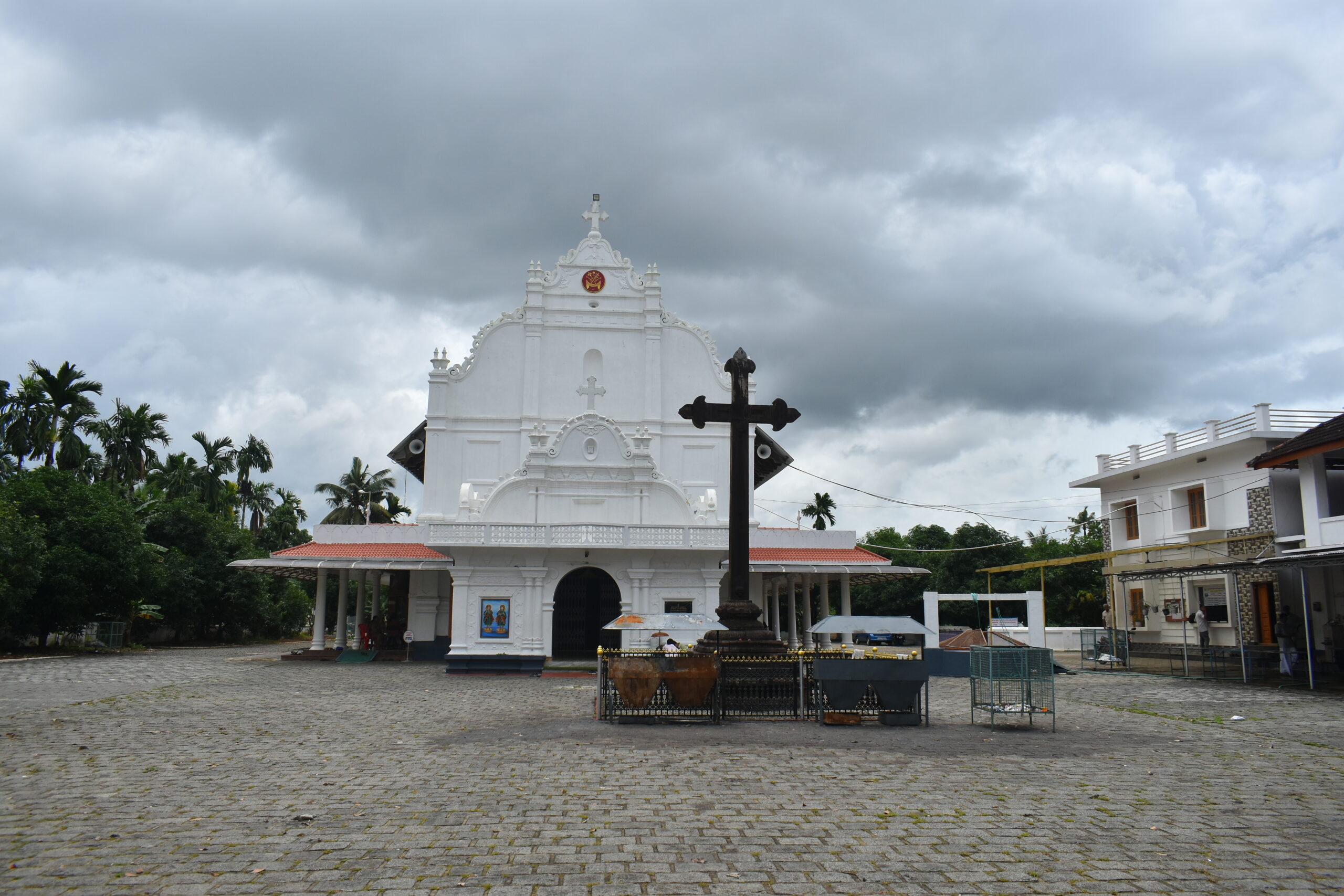
Kanjoor Church
Kanjoor Church
Kanjoor, Ernakulam district
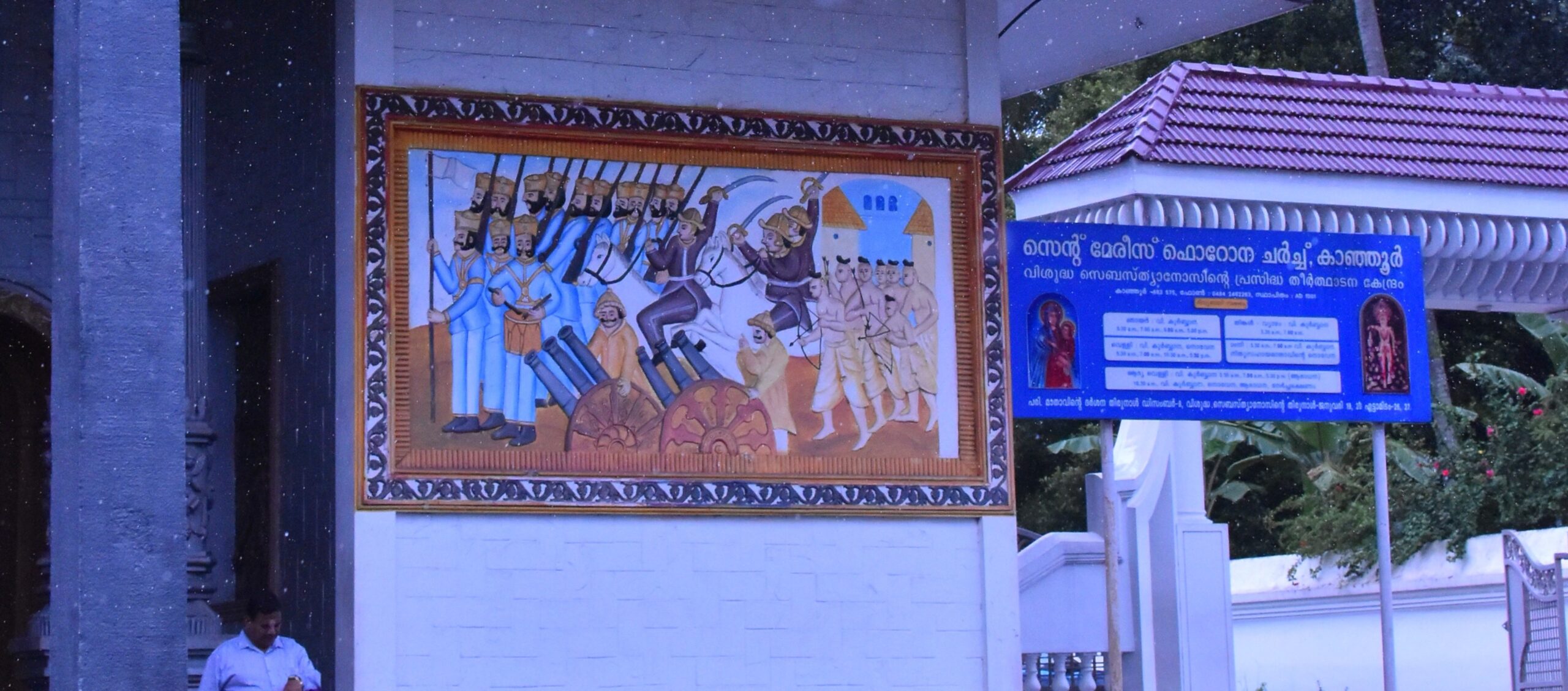
A mural of historical significance is found at Kanjoor church — of the Travancore army defeating the Mysore troops (Sasibhooshan 1994). This battle scene is exceptional within the church mural tradition: secular in subject, it records a defining moment of the region's military history on sacred walls — a reminder that these murals did not confine themselves to biblical narrative alone.
Scholarly Focus · Granziera 2017
St. Mary's Church, Angamaly
The article "Cultural Interactions and Religious Iconography in 16th Century Kerala: the Mural Paintings of St. Mary's Church in Angamaly" (2017) by Patrizia Granziera, though focusing on one particular site, is interesting because it highlights the similarities — including the representation of the Immaculate Conception, the crucifixion, and the image of heaven and hell — with Christian art of Catholic Portugal and Spain.
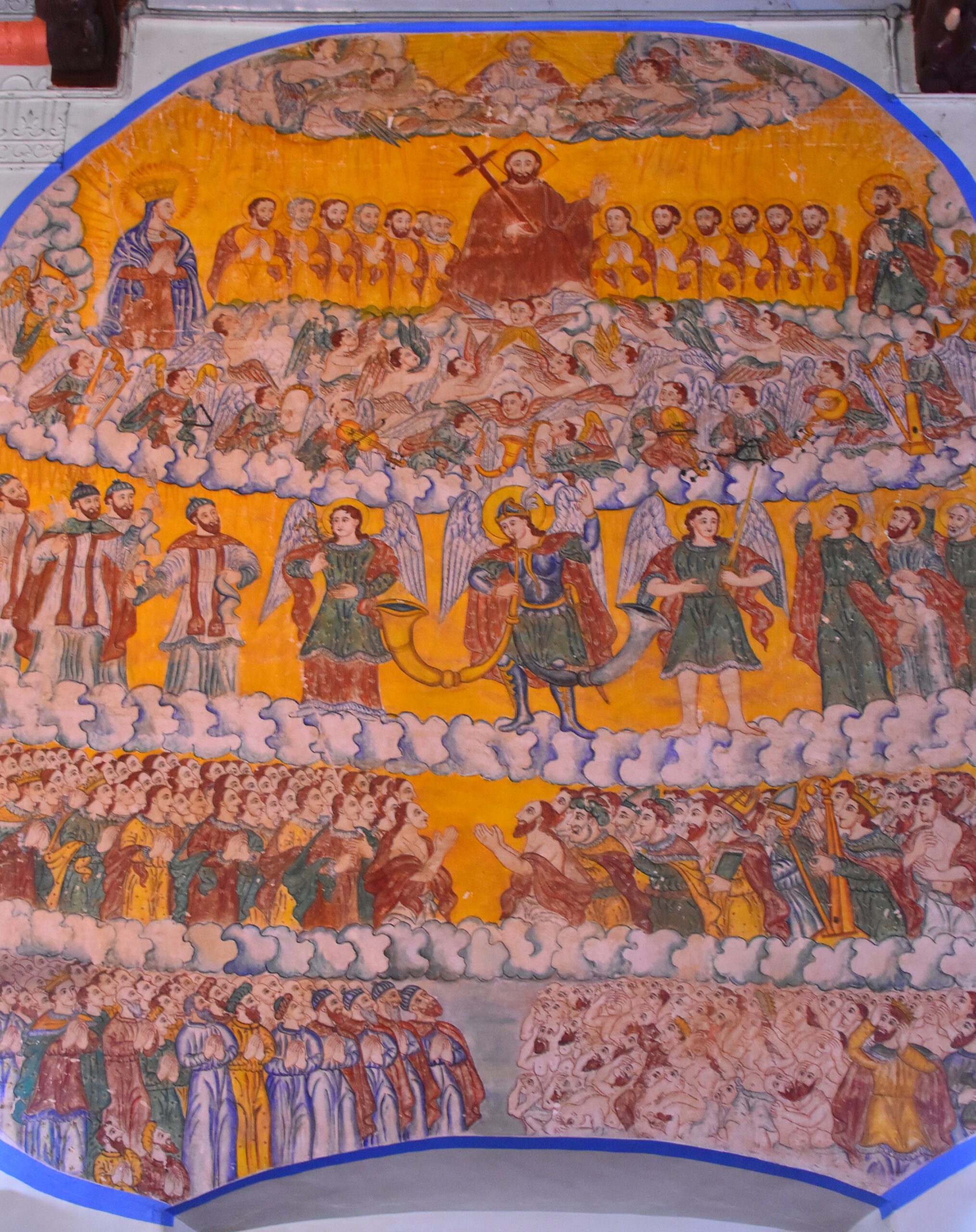
Native elements within a foreign faith
St. Mary's Church, Angamaly
However, there are also some native elements in the paintings, including lotus blossoms, makara animals, and regional fruits and clothes. The local artists, trained in the same conventions as temple painters, could not — or did not — wholly suppress the visual vocabulary they had grown up with.
The article also rather boldly argues that the Catholic friers tried to depict Hindu Bhagavati as Satan in their murals. This demonization can be understood as a deliberate attempt to send a warning to the Hindu converts, who revered Bhagavati as the village protector goddess.
Kerala Mural Archive · Fieldwork
Churches documented for this archive
Three church sites were visited and photographed during fieldwork. Incomplete documentation means they fall outside the main archive — they are presented here as part of this visual essay.
Kanjoor Church
Notable for the historically significant mural of the Travancore army defeating the Mysore troops — one of the few secular battle scenes in Kerala's church mural tradition.
Akaparamb Palli
Kollam Akaparamb is among the significant churches listed in the Peter & Gopi monograph. Fieldwork photographs are available; documentation remains incomplete.
Angamali Valyapalli
St. Mary's Church, Angamaly — the central subject of Granziera's 2017 study — where lotus blossoms and makara animals appear alongside representations of the Immaculate Conception.
References
Scholarly sources
Peter, Jenee and P K Gopi. Church Mural Art of Kerala. 2009.
Granziera, Patrizia. "Cultural Interactions and Religious Iconography in 16th Century Kerala: the Mural Paintings of St. Mary's Church in Angamaly." 2017.
Kurisummoottil, George. "An Iconographic Explanation of the Mural Painting of the Paliekara Church, Thiruvalla." 2004.
Sasibhooshan. Keralathile Chuvarchithrangal. 1994.