Origins
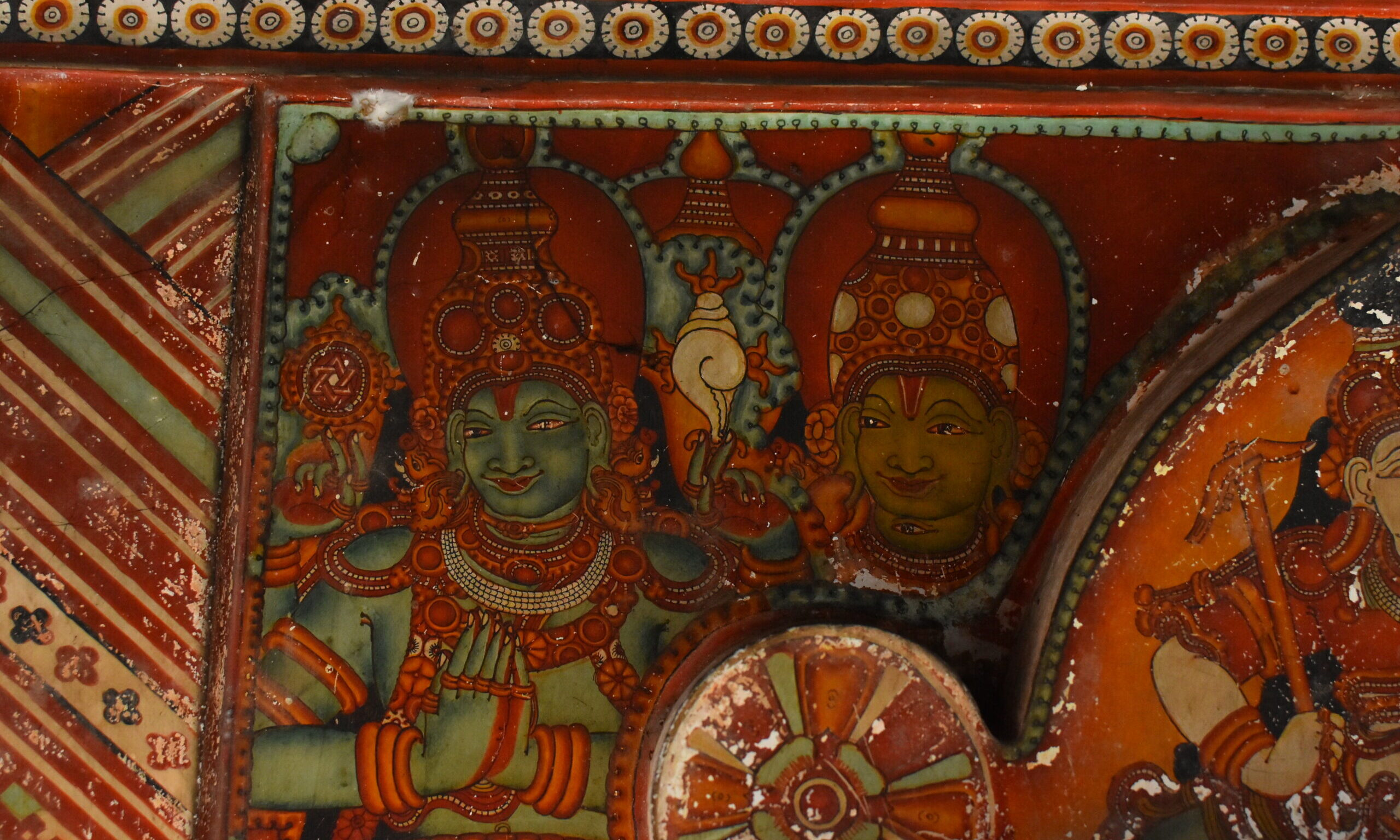
They were not decorating the walls.
They were making the god present.
The First Question
Stand before any Kerala mural and you will eventually ask: why is it here?
The answer that most art history gives you is a familiar one. Patronage. Royal ambition. The desire of kings and temple authorities to demonstrate piety and power through visual magnificence. Murals as sacred decoration — the highest expression of a tradition of ornamentation that runs through Indian temple architecture from its earliest periods.
This is not wrong. But it is incomplete.
The painters were working inside a different understanding entirely — one in which the image was not a representation of the divine but a site of divine presence.
To understand where Kerala murals came from, you have to start here — with the intention behind the first brushstroke, not the brushstroke itself.
Origins in the Oldest Sense
The tradition of drawing on walls runs deeper than any specific art form. It is among the earliest human impulses — visible at Bhimbhetka, Ajanta, Vatapi, and Thanjavore, in sites where the major themes were drawn from Buddhist and Jainist mythology. Images made not as decoration but as vehicles for devotion. Not to show what the world looked like but to make the sacred present within it.
Kerala mural painting grew from this root. Its historical origins date to the eighth century. Before structural temples provided the walls that would become the tradition's primary surface, the Dravidian Kalamezhuthu tradition was prominent in Kerala — coloured powders used to draw temporary images of deities on the ground. The permanent image on the wall was, in one sense, simply a more lasting version of the same devotional act.
What distinguished it was the permanence. And permanence carried obligations that temporary images did not.
The Will to Evoke Piety
The Sanskrit texts that governed Kerala mural painting — principally the Tantrasamuchaya and the Thachu Shastra — are not aesthetic manuals. They are ritual ones. They specify not only what should be painted and how, but what the painter should be — spiritually, physically, mentally — before the brush touches the wall.
The painter fasted. He prayed. He underwent ritual purification. He meditated on the deity he was about to draw, held the dhyana sloka — the Sanskrit verse describing the divine form — in his mind completely, and only then began, facing east.
The painter was not an artist executing a commission. He was a devotee performing an act of worship.
The unmeelanam ceremony — the filling of the pupils of the most important figures, the last act of any mural composition — was performed before a lighted lamp, accompanied by prayers and the sounds of conch shells. After the pupils were drawn, the image was believed to come alive.
The murals were painted to evoke bhakti — devotion — in the viewer. But they began as acts of bhakti in the painter. That doubled devotional logic is what Kerala murals were made to do. It is not what decoration does.
Twelve Centuries — A Brief Timeline
From cave to wall to screen — how the tradition moved through time.
The earliest surviving mural sites date to this period — Thirunanthikkara, Kanthaloor, Thrivikramamangalam. Cave temples give way to structural temples under Aryan influence. The visual grammar of the tradition begins to standardise.
The five-colour system, iconographic typologies, and compositional conventions become standard. The primary textual sources — Chitrasoothram and Chitralakshana — codify what painters must do, what they must avoid, and what their inner state must be before beginning.
The classical boom. Competing patronage networks — the Zamorin of Calicut, the Raja of Cochin, the rulers of Travancore — drive the most ambitious mural programmes Kerala has seen. Mattancherry Palace, Krishnapuram Palace, the great temple complexes of Thrissur and Thiruvananthapuram. The works we consider canonical today emerge in this period.
The colonial disruption. Tipu Sultan's attack and subsequent British rule dismantles the patronage network that sustained the tradition. European painting styles enter Indian artistic consciousness. New commissions decline sharply. The tradition contracts.
Revival, loss, and survival. The fire at Guruvayur temple in the 1970s prompts a reassessment of what is disappearing. Formal institutions transmit the tradition. Second-generation artists take it online. The tradition is alive. It is also fragile in ways it has never been before.
The Map
Mural sites documented in this archive — primarily within Ernakulam and Thrissur districts of Central Kerala, the geographic scope of the doctoral research from which this archive emerged. Each point links to the corresponding location in the archive.
The full extent of what was painted across Kerala across twelve centuries is not knowable. What this archive holds is a fraction of a fraction of what once existed. That is not a reason for despair. It is a reason for urgency.
Go Deeper —
Three Pathways
Each pathway opens a different door into the same tradition. Choose the one that matches your question.
History of Kerala Murals
From the cave paintings of prehistoric India to second-generation artists posting reels on social media — a complete history of how the tradition emerged, flourished, contracted, and survived.
Explore →Dynastic Patronage
The tradition required patrons — rulers, temple authorities, communities. This page traces the networks that shaped which murals were painted, where, and why, from the Zamorins to contemporary institutions.
Explore →The Living Tradition
New murals are being painted. New artists are trained. But the conditions that sustained this tradition for a thousand years have changed — and it is negotiating those changes in real time.
Explore →From Origins to the Archive
Understanding where Kerala murals came from changes how you see them in the archive. The painter who made the Mattancherry Ramayana wall was not decorating a palace. He was, in his own understanding, making the divine present on the wall — through ritual preparation, through devotional precision, through a line drawn with meditative steadiness and completed with the unmeelanam ceremony that gave the image life.
That intention is still legible in the paintings, for those who know how to look.
This archive is one place to learn how.
Explore the Archive →