Englishമലയാളം

Shivathandava

Living Tradition · The Present Day

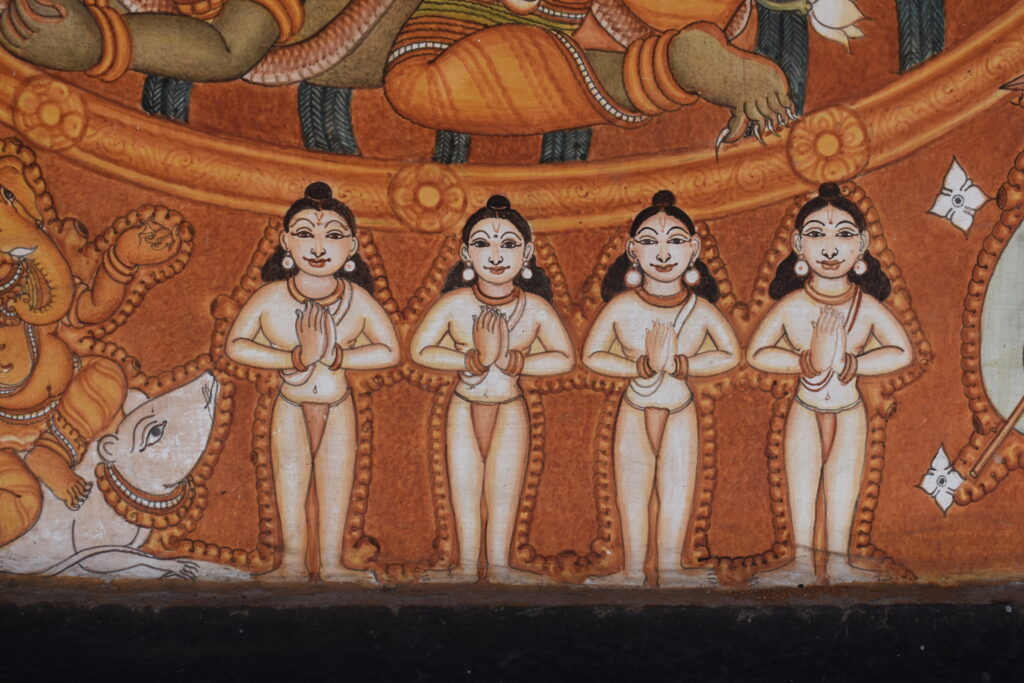
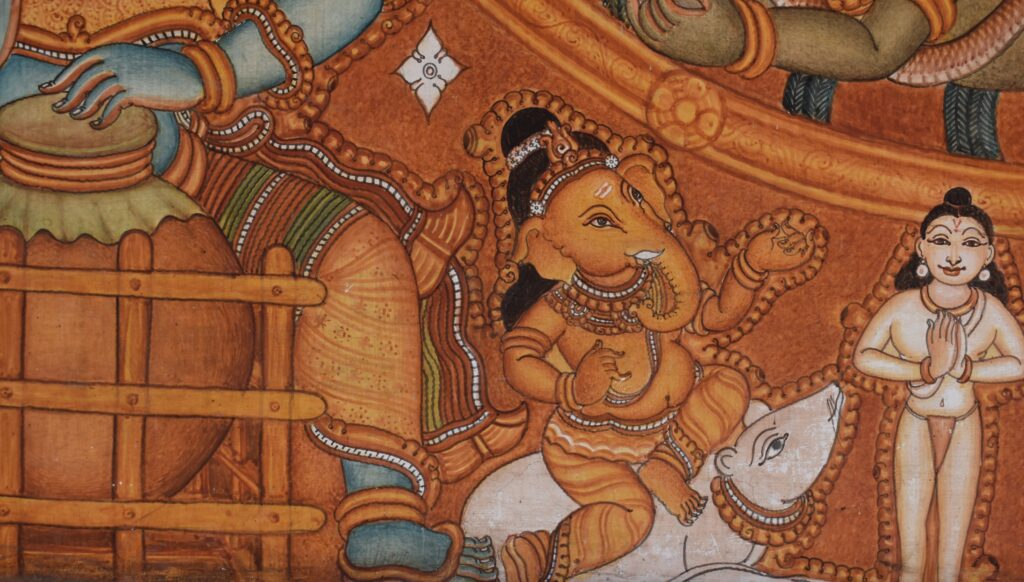
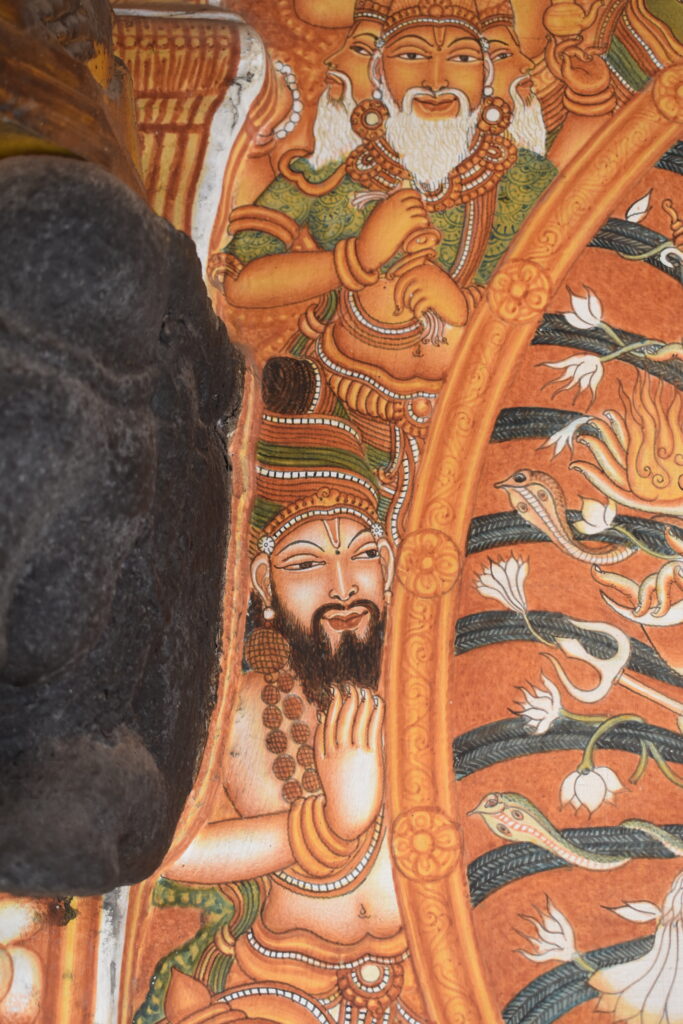
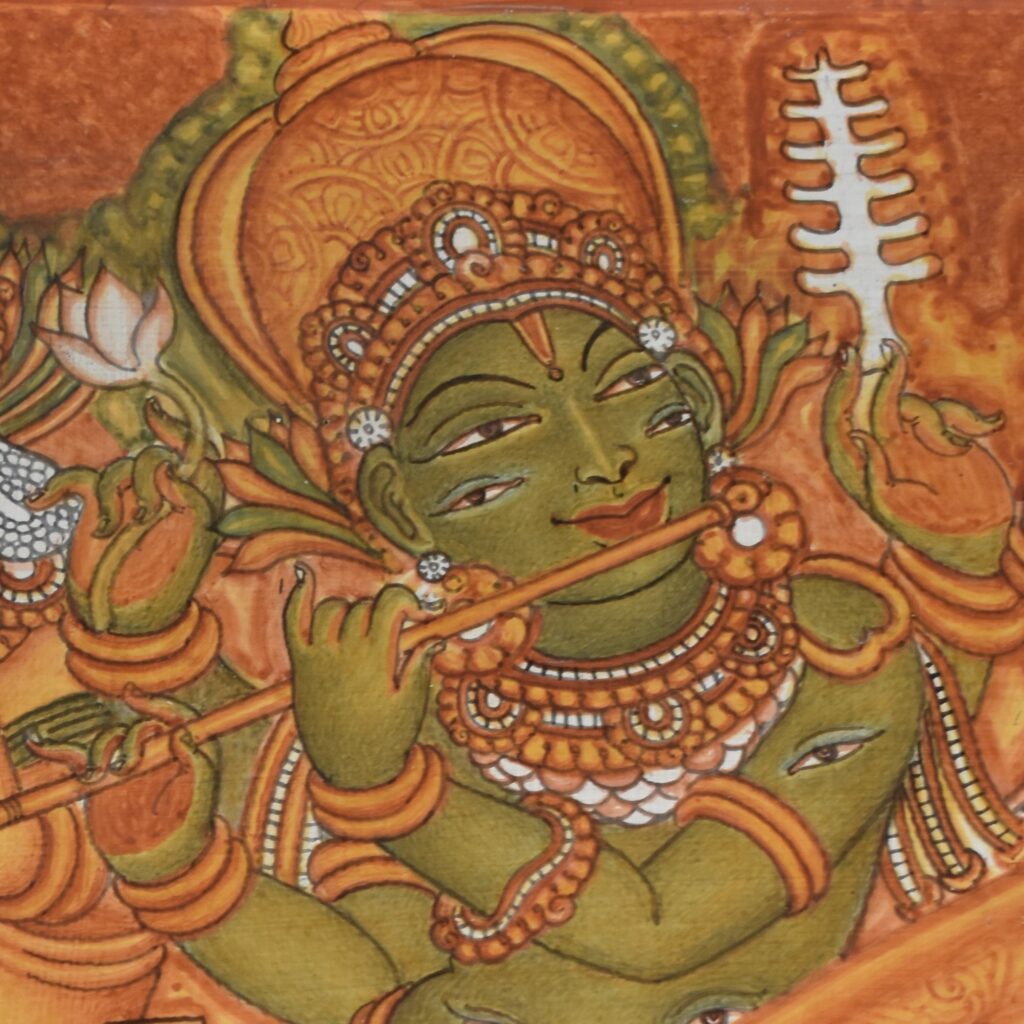
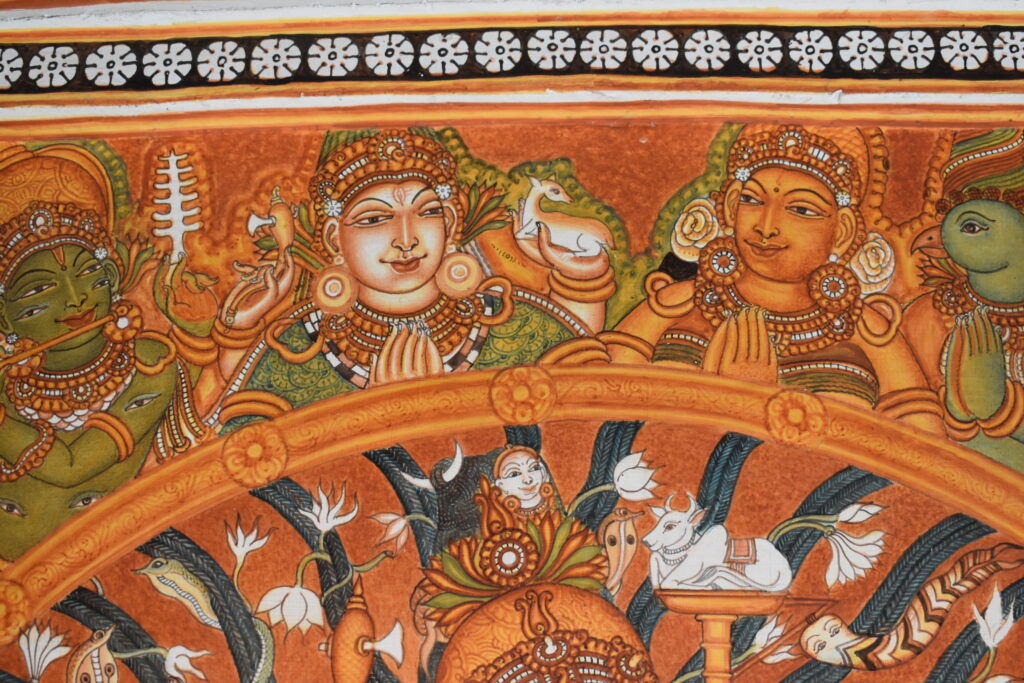
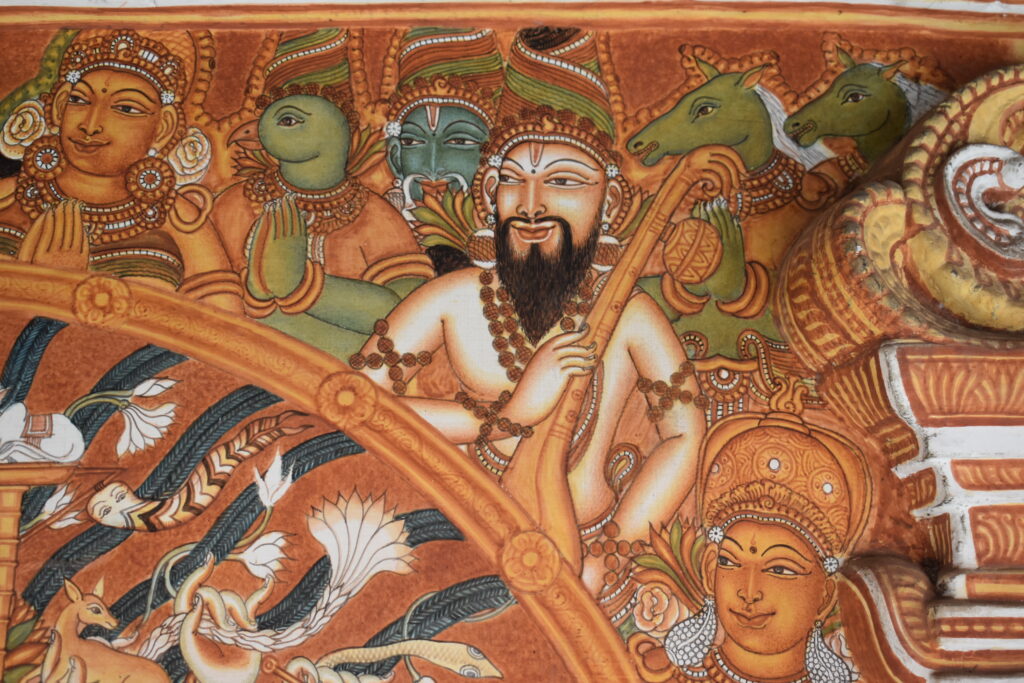
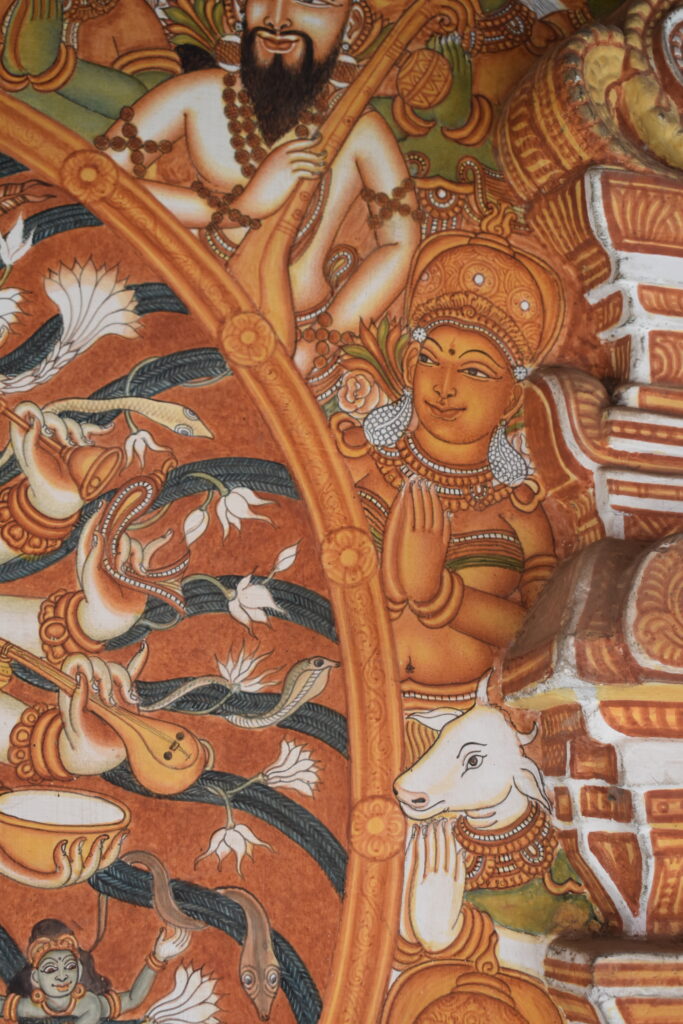
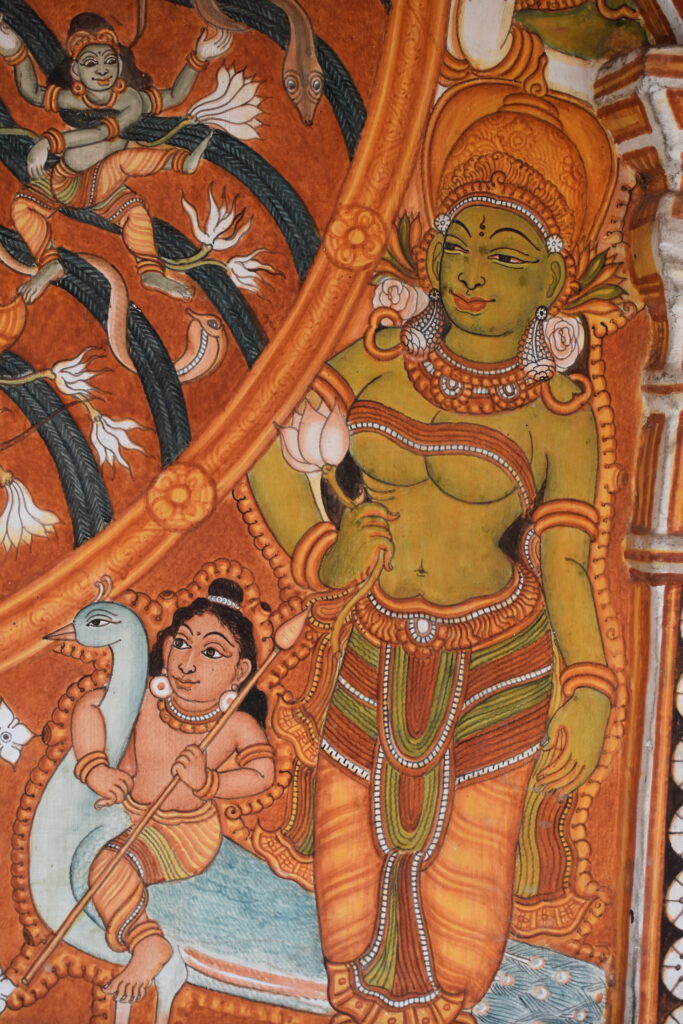
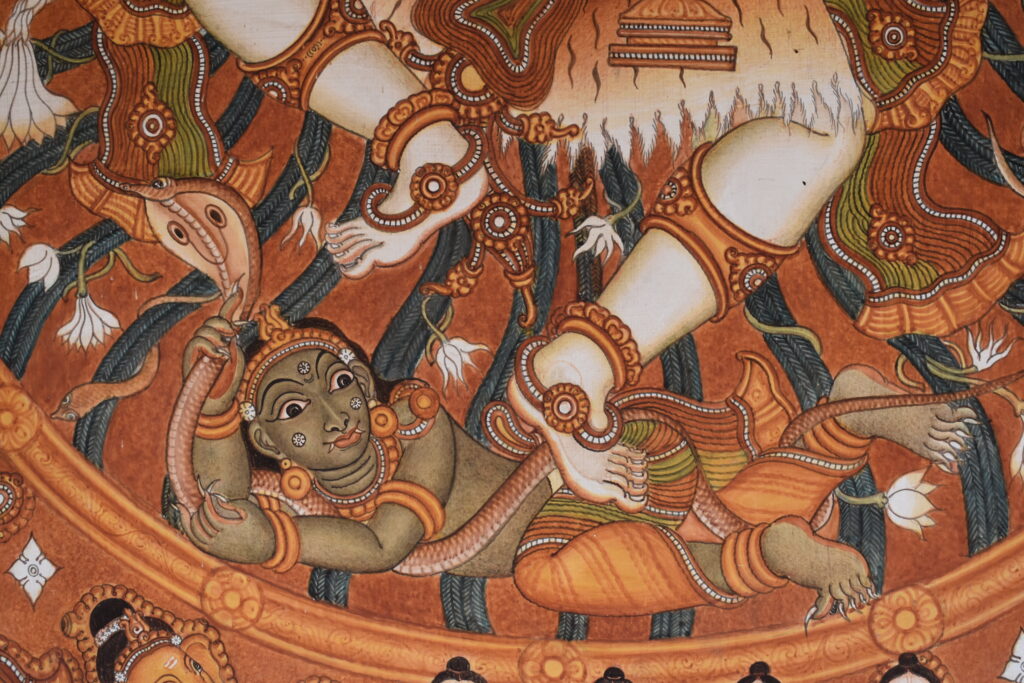
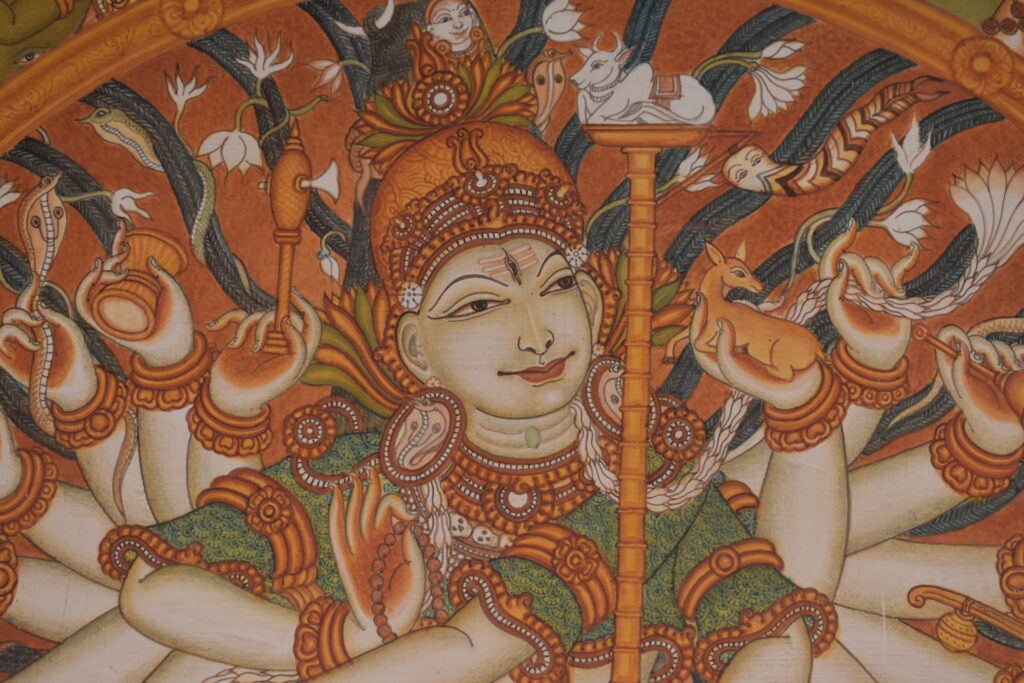
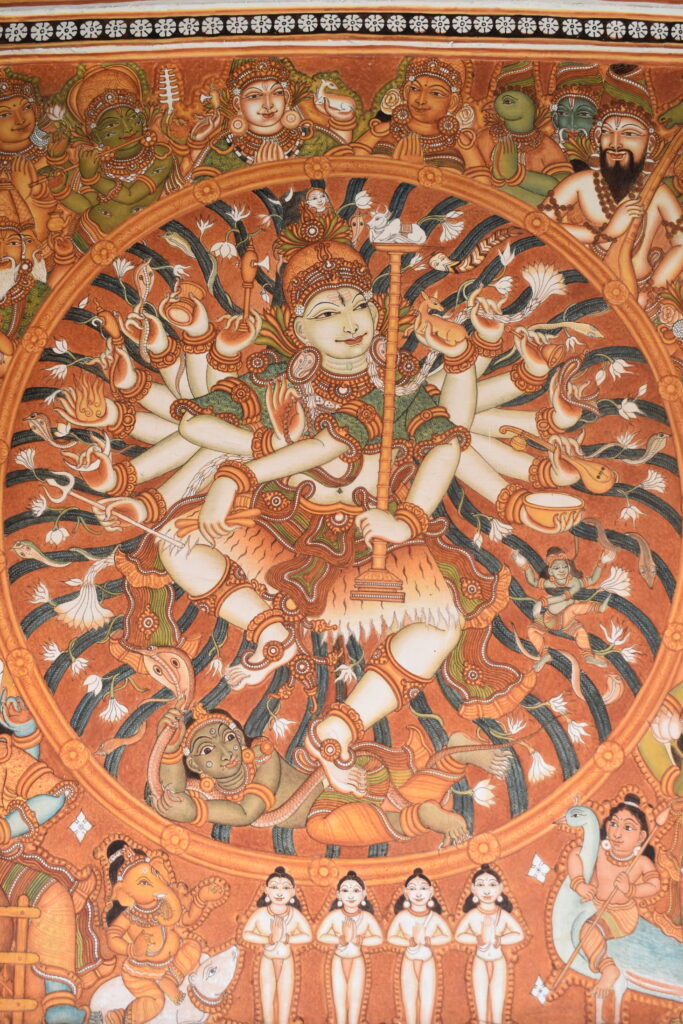
Devas, bhoothaganas and sages gather around as onlookers. Shiva is the magnificent central figure with 16 arms each holding a weapon or other symbolic element. Shiva appears as Nataraja within a great circular aureole bordered by a repeating rosette medallion, his many arms fanned outward in a dynamic dance pose. His pale complexion and tall crown of matted locks are adorned with a small figure of Ganga, a crescent moon, and a miniature Nandi, while a serpent coils across his chest and arms. His attributes span a trident (trishula), a small hand-drum (damaru), a deer, a conch, a bowl, a stringed instrument, and a tongue of fire — several carried in hands ringed by snakes whose sinuous bodies double as the rays of the halo itself. He wears the flared, richly patterned lower garment characteristic of the dance, one leg raised mid-motion, the other planted on a small prostrate figure beneath his feet. Below the roundel, four celestial women stand in anjali mudra, flanked by Ganapathi at the lower left and a figure riding a peacock (likely Subrahmanya) at the lower right. Above, rows of divine witnesses look on, including a bearded ascetic playing a stringed instrument and several green-skinned attendant figures with folded hands.

Narrative

Textual Source
Non-narrative
Mythological Tale
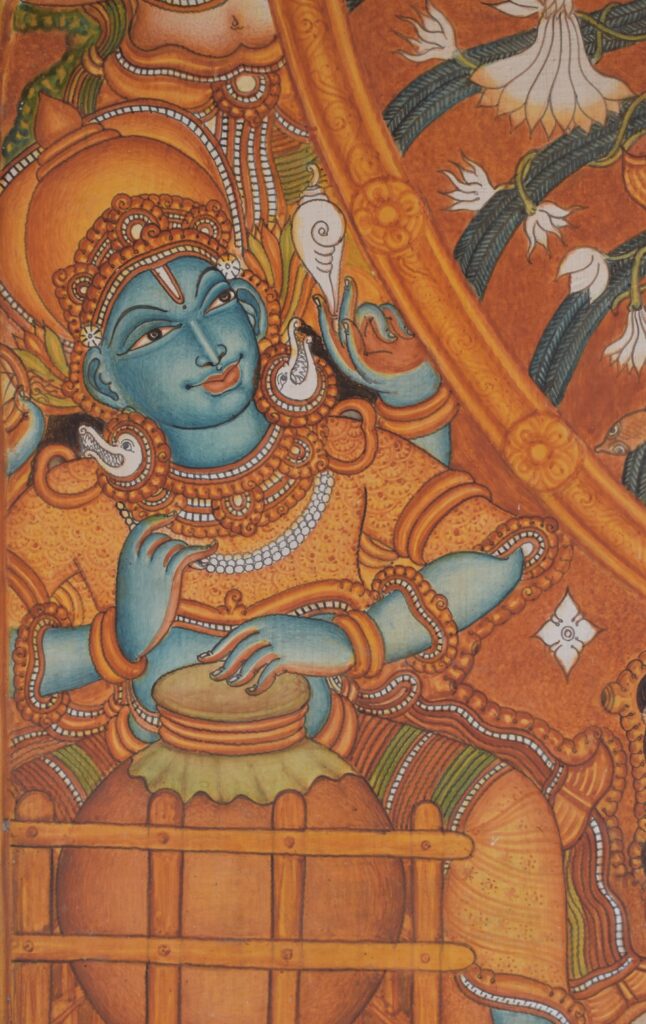
Iconic cosmic-dance form. This is the Ananda Tandava, Shiva's cosmic dance of bliss, performed before the assembled gods and sages. The dance holds creation, preservation, and destruction within a single continuous motion — Shiva dances the universe into being, sustains it, and will one day dance it into dissolution. The dwarf figure crushed beneath his foot is Apasmara (Muyalaka), the demon of ignorance and forgetfulness, whose defeat represents the triumph of divine awareness over illusion. The assembly of witnesses — devas, sages, and family members including Ganapathi and Subrahmanya situates the dance not as a private act but as a cosmic event, seen by the whole of creation. The mizhaav, played by the Vishnu depicts the local Keralaite influence.
Episode
Nataraja / Shiva Tandava

Iconography

Primary Deity/Figure
Shiva
Secondary Figures
Brahma, Ganapathi, Indra, Narada, Parvathi, Subrahmanya, Vishnu; sages
Iconographic Form
Shivathandava
Iconographic Attributes
Shiva is shown with 16 arms fanned symmetrically outward, several ringed by serpents whose bodies extend into the radiating rays of the halo itself. Identifiable attributes held across the hands include a trident (trishula), a small hand-drum (damaru), a deer, a conch (shankha), a bowl, a stringed instrument, and a tongue of flame (agni) — the damaru and fire together marking the dance as creation and destruction held in the same gesture. Third eye visible on the forehead; tall matted locks (jata-mukuta) piled upward and adorned with a small figure of Ganga, a crescent moon, and a miniature Nandi. Pale/white complexion, heavy jewelry at the neck, arms, and ankles (the ankle ornaments typically bearing small bells in this dance form). Lower garment is a flared, richly patterned wrap characteristic of the tandava pose, one leg raised and bent mid-motion, the other planted on a small prostrate dwarf figure — Apasmara/Muyalaka — crushed beneath the foot. Vishnu is blue-skinned with four arms, two of which is playing the musical instrument mizhaav, two holding the conch shell shankhu and sudarshana chakra. Brahma is shown with his three heads. Ganapathi has elephant-trunk face and is atop a mouse, his mount. Subrahmanya is atop his peacock and holding a vel. Parvathi is green-skinned holding a lotus flower. Narada holds his Veena. Nandi is depicted as the bull with anjali mudra posture. Indra is identified by eyes all over his body and is shown here playing a flute. He is green in colour.
Visual & Formal Features
Facial expression detail, Hand gesture (mudra), Ornamentation
Rasa
Shanta

Spatial & Architectural

Temple
Sanctum
Zone within Temple
Sanctum
Position in Pradakshina Sequence
16
Adjacent Panels
Girijakalyanam, Dakshinamoorthy

Condition & Documentation

Condition
Excellent
Deterioration Type
None observed
Restoration Status
Unrestored
Documentation Type
DSLR full panel
Permission Basis
Temple authorities
Date of Documentation
22/08/2024
Artist
Senthil
Identifier
THL_P016
Rights / Notes
These images may not be reproduced, redistributed, or used for commercial purposes without prior permission.