Dynastic Patronage
How Kerala's Rulers Made the Tradition Possible
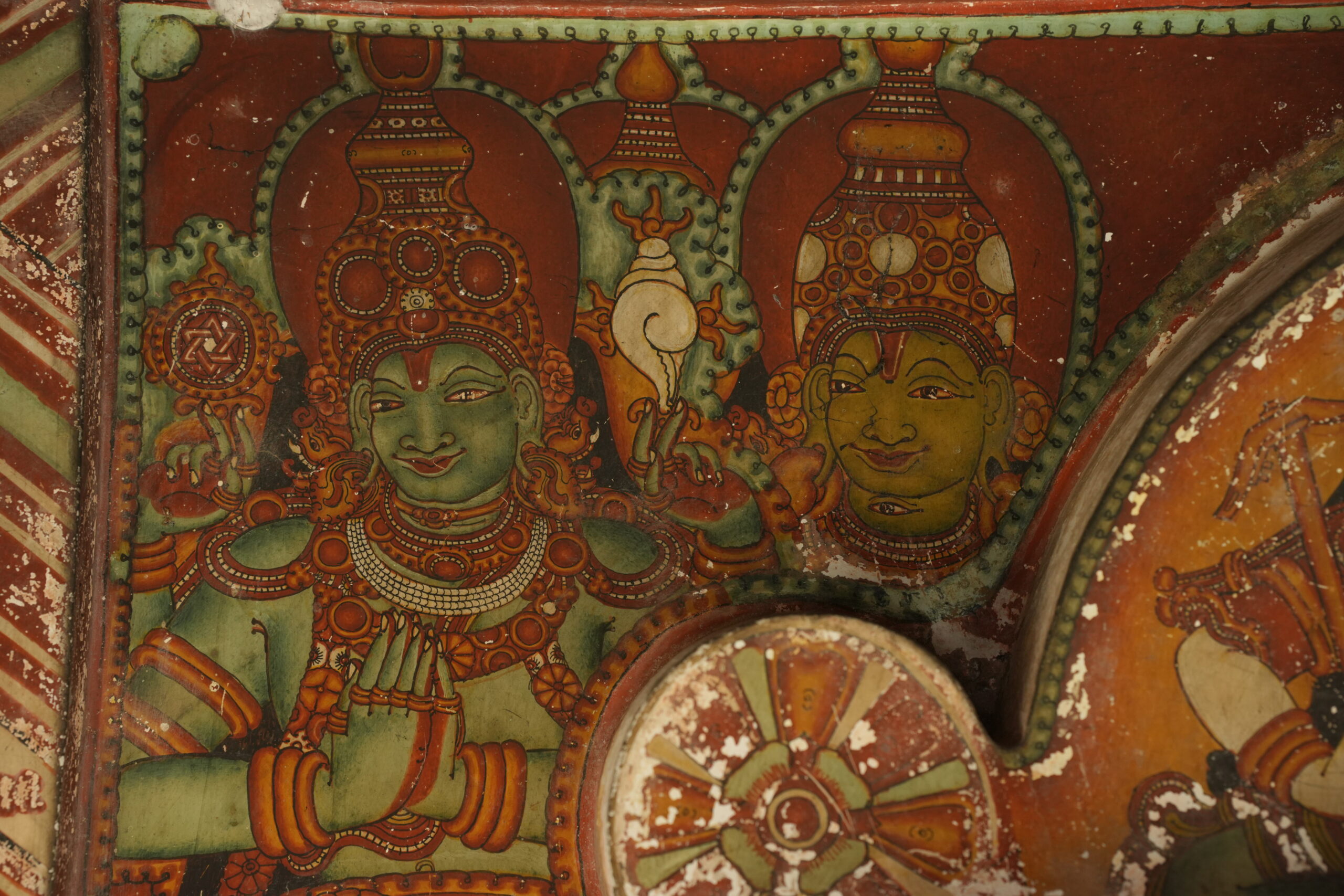
These walls were not painted by accident. They were commissioned by people who understood that power and devotion were not separate things.
Why Patronage Mattered
No tradition of sacred art sustains itself on devotion alone. It requires material support — the commissioning of work, the payment of artists, the provision of temple and palace spaces in which painting could happen. In Kerala, that support came primarily from the region's ruling dynasties and its temple authorities, whose investment in mural painting spanned nearly a thousand years.
Understanding dynastic patronage is not a marginal concern for the study of Kerala murals. It is central to it. The distribution of surviving mural sites across Kerala, the periods of greatest artistic ambition, the choice of which mythological programs were painted where — all of these were shaped by who held power, what they wanted their power to express, and how they understood the relationship between kingship and the sacred.
Kerala mural painting was at its zenith from the fifteenth to the eighteenth century. This was not a coincidence of artistic talent. It was a consequence of competing patronage networks.
The Early Foundations
The shift from cave temples to structural temples in the eighth and ninth centuries — driven by Aryan cultural influence — created the architectural conditions for mural painting on a significant scale. The earliest surviving sites, including the Thirunanthikkara murals estimated to the ninth century, represent a tradition already supported by temple authorities with the resources to commission complex multi-figure programs.
The Kulashekhara Perumals and their successors in the tenth to twelfth centuries provided the political framework within which the tradition consolidated its visual grammar. Under their patronage, the five-colour system, the iconographic typologies, and the compositional conventions that would persist for centuries became standardised.
The inscription at the Udayampeeroor Kadavil Thrikkovil temple, recording murals completed in 957 AD, provides one of the earliest direct evidences of documented patronage — and records the remarkable fact that communities without formal temple entry rights at that time contributed to the temple's renovation. Even patronage, in this instance, was shaped by political circumstance.
The Classical Patrons
The period of greatest artistic flourishing coincides with the consolidation of Kerala's major ruling houses and their competition for prestige, legitimacy, and devotional authority.
The Zamorin of Calicut
The Zamorins were among the most powerful rulers of medieval Kerala, controlling the lucrative spice trade through Calicut and projecting their authority through substantial temple patronage. Their support for the arts extended beyond mural painting to Kathakali and other classical traditions — a reminder that patronage of the visual arts was part of a broader cultural economy of royal legitimacy.
The Raja of Cochin
The Dutch Palace at Mattancherry — built by the Portuguese, gifted to the Raja of Cochin, renovated by the Dutch — houses the most complete surviving example of Kerala's mural tradition: the Ramayana cycle that covers all four walls of the bedchamber. That this program survived in a palace that passed between European colonial powers and a local ruler speaks to the durability of the tradition even under political disruption.
The Rulers of Travancore
The Travancore royal family were among the most significant patrons of temple arts in Kerala's history. The Krishnapuram Palace in Kayamkulam houses the largest single Kerala mural in existence — the Gajendra Moksham panel, measuring approximately 14 by 10 feet. The rulers of Travancore understood devotional patronage as simultaneously religious and political — an expression of their role as servants of Padmanabha, the deity to whom they formally surrendered their kingdom.
The Temple Authorities
Alongside the ruling dynasties, Kerala's temple devaswom boards and temple trusts played an essential role in sustaining the mural tradition. Temples were not passive recipients of royal patronage — they were active institutions with their own resources, their own governance structures, and their own decisions about when and how to commission mural work.
The patron's role was to fund the work and choose the site. The tradition's accumulated rules determined what appeared on the wall. Even the wealthiest patron could not simply impose their own preferences on a temple mural program.
The Colonial Disruption
The collapse of the traditional patronage system began with the military and political disruptions of the late eighteenth century. The attack of Tipu Sultan and the subsequent consolidation of British rule dismantled the network of relationships between ruling houses, temple authorities, and artists that had sustained the tradition for centuries.
With British rule, European painting styles entered Indian artistic consciousness. The popularity of Raja Ravi Varma — himself a member of the Travancore royal family — drew many artists away from the Kerala mural tradition toward naturalistic oil painting on canvas. New commissions declined. Artists without patrons sought other work.
The fire at Guruvayur temple in the 1970s, which destroyed the mural program there, became the symbolic moment of reckoning — the point at which the scale of what was being lost became impossible to ignore.
Patronage Today
The revival of the Kerala mural tradition from the 1980s onwards has involved a different patronage structure from its classical predecessor. Formal institutions — Guruvayur Devaswom Mural Institute, Ernakulam Ravipuram Indian School of Arts, Kalady Sree Sankaracharya University, Aranmula Vasthuvidya Kendra — now provide the institutional support that ruling dynasties once provided.
New categories of patron have emerged. Hotels and commercial spaces commission mural work. Private collectors commission murals for domestic spaces. Cultural institutions commission work for public display.
Whether these new patronage structures can sustain the full depth of the tradition — its ritual preparation, its devotional intent, its theological precision — or whether they preserve primarily its visual surface, is one of the central questions facing the tradition today.