Kerala Mural Archive · Space & Ritual
The Ritual Context
What it means to see a mural in a temple
Meaning in these works is not derived from iconography alone. It is constituted through the performative conditions of encounter — the ritual movement of pradakṣiṇa, the architecture of the sanctum, the spatial sequencing of the devotional gaze.
To look at a Kerala mural painting in a temple is not to look at a picture. It is to participate in a structured devotional act — one whose conditions of encounter, built up over more than a thousand years, are as much a part of the work as the pigments and lime plaster that carry it.
This page documents those conditions: the ritual framework within which the murals were made, the spatial and temporal structures within which they are encountered, and what it means for those conditions to change — as they inevitably do — when the paintings are moved into digital environments.
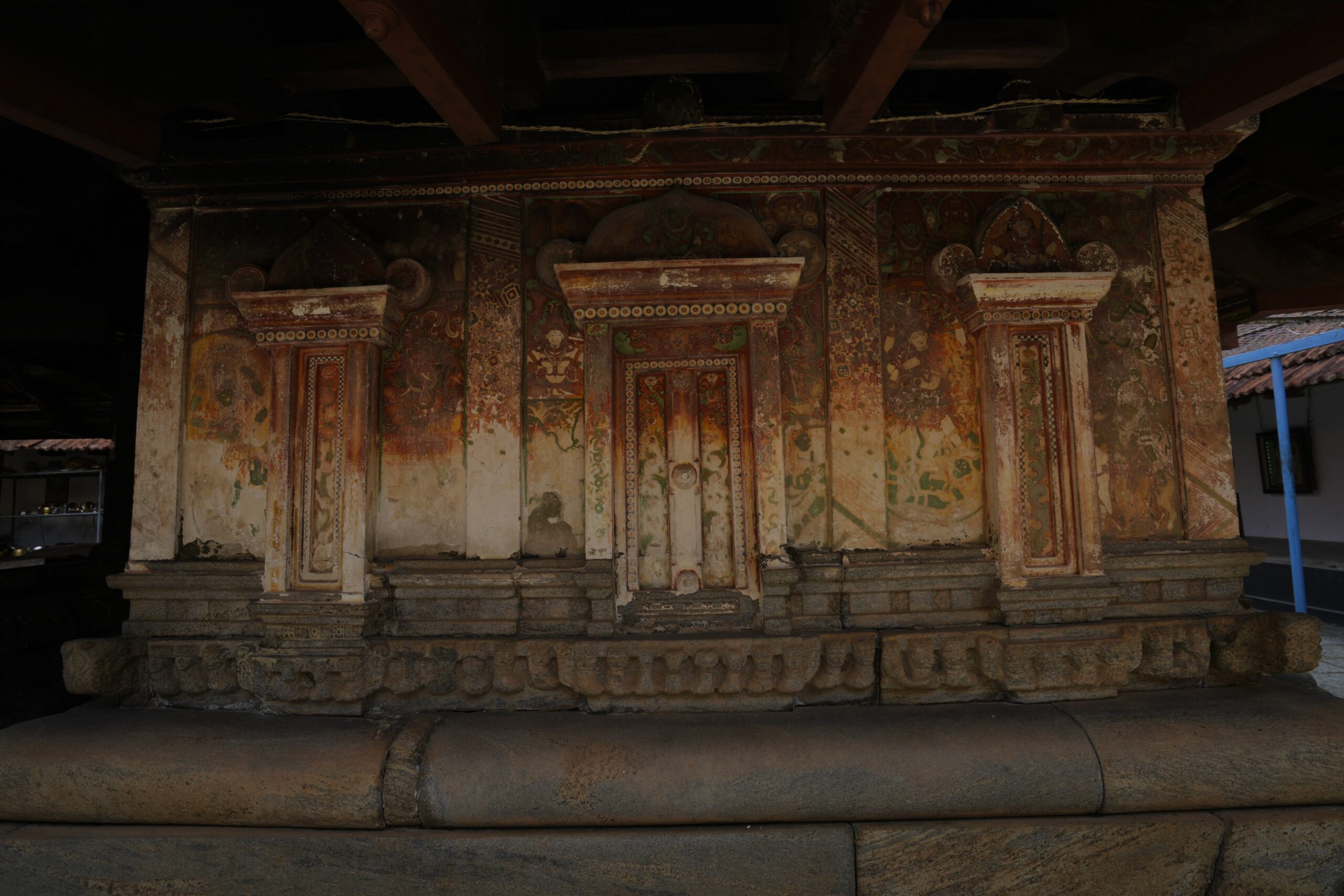
Interior walls of Kadavil Thrikkovil Sreekrishna Swamy Temple.
The Act of Seeing
Darśan — a mutual and devotionally charged exchange
Darśan is a Sanskrit term meaning, at its most literal, "seeing." But in the context of sacred Hindu images, it names something more specific and more demanding than passive visual reception. The devotee does not merely look at the deity. The deity looks back. Seeing, in the temple context, is a mutual and devotionally charged exchange — one in which the act of looking is itself a form of worship, inseparable from the physical presence of the image and the bodily orientation of the viewer.
This has a direct consequence for understanding Kerala mural paintings. The mural image does not represent the divine; it makes the divine present. A mural of Vishnu in the inner corridor of a temple is not a depiction of Vishnu placed there for aesthetic contemplation. It is a site of Vishnu's presence — encountered bodily, progressively, and within a regulated spatial order that the temple architecture provides.
The mural paintings that line the circumambulatory pathways of Kerala temples are, within this framework, active participants in the devotional encounter — not decorative additions to the ritual space, but elements of a visual theology in which sight is the primary mode of religious knowing. Their placement, their sequence, their height, their relationship to lamplight: all of these are conditions of darśan, and all of them are constitutive of the mural's meaning.
Movement as Meaning
Pradakṣiṇa — the clockwise walk that structures encounter
The ritual practice of pradakṣiṇa — the clockwise circumambulation of the sanctum sanctorum — is the primary spatial framework within which Kerala mural paintings are encountered. Pradakṣiṇa is not incidental to mural viewing; it is constitutive of it.
Mural panels are positioned along the inner walls of the circumambulatory corridor — not for frontal, distanced contemplation, but to be passed at close range, progressively, in a direction determined by the ritual walk. No single vantage point exists from which the entire mural programme can be surveyed at once. The sequence is available only through movement. The narrative logic of the images — episodes from the Ramayana, the Mahabharata, the Puranic traditions — is experienced as a spatial and temporal unfolding, not as a set of discrete illustrations to be read in any order.
Fieldwork at Vadakkunnathan Temple, Thrissur confirmed this spatial logic as the governing condition of mural encounter. The Mahabharata panels are positioned at specific intervals along the pradakṣiṇa path, with each panel coming into view progressively as the walk proceeds. The viewer who completes a single circuit has encountered the mural programme in a sequence determined entirely by the temple's architecture — not by their own preference or attention.
The body moving through sacred space is not a passive receiver of the mural programme. It is a participant in the production of the encounter — its angle of approach, its pace, its proximity to the wall at each moment, all part of what the mural means in that instance. Movement through the corridor is itself a meaning-making practice, not merely a means of getting from one panel to the next.
From Fieldwork Across Twelve Sites
Four conditions that constitute ritual mural viewing
Ethnographic fieldwork conducted across twelve temple sites in Ernakulam and Thrissur districts identified four inter-related dimensions of temple mural viewing. Together these constitute what this research terms the performative conditions — the specific material, spatial, and ritual circumstances through which mural paintings acquire their meaning.
Spatial organisation and circumambulatory movement
Pradakṣiṇa
Panels are encountered through movement, not frontal contemplation. The sequence, angle of approach, and proximity are determined by the corridor's architecture. At Chemmanthatta Mahadeva Temple, the narrower corridor creates an intimate proximity — the painted surface looms at close range as the viewer rounds each corner, revealing different compositional aspects with each change of angle.
The architecture of selective visibility
Light, shadow, and contingent encounter
Temple interiors are characterised by low and directional light, deep shadows, and zones of visibility that shift with time of day, season, and the number of oil lamps lit during ritual. At Thirunayathode Sivanarayana Temple and Alangad Sree Santana Gopala Murthy Temple, certain panels were only partially visible during fieldwork visits, significant portions obscured in shadow. The mural is never fully available at once; it reveals itself gradually, contingently, and through repeated encounter.
Ritual temporality and collective presence
Embedded in worship cycles and festival time
Temple mural viewing is embedded in the structured rhythms of daily worship, festival cycles, and ceremonial occasions. At Peruvanam Mahadeva Temple and Vadakkunnathan Temple — both sites of significant annual festivals — the mural programme was encountered under radically different conditions during festival visits versus regular daily visits. During festivals, the mural panels function not as objects of individual aesthetic attention but as participants in a shared ritual environment.
Image, architecture, and mythic narrative
The relational embedding of image within space
Kerala mural programmes are not collections of individual images. They are architecturally integrated narrative and devotional systems whose meaning is constituted through the relationships between panels, between the painted programme and the architectural space, and between the visual content and the ritual function of the space. An individual panel, extracted from this relational context, loses meaning that its position within the larger programme provides.
Before the First Line
The ritual obligations of the painter
The ritual context of Kerala mural painting begins long before the first line is drawn. The painter's own preparation — devotional, bodily, and temporal — is as much a part of the tradition as the technical skill that follows.
Step 1
Choosing the auspicious day
An auspicious day is selected for the commencement of the drawings. The timing of beginning carries ritual weight; not every day is equally propitious for the work of making a deity present in painted form.
Step 2
Seeking the blessings of god and guru
Before beginning, the artist seeks the blessings of both the deity to be depicted and their own guru. In some cases, puja is performed on the brushes themselves — consecrating the instruments of making before they touch the wall.
Step 3
Meditation and the dhyana sloka
The artist meditates and recites the dhyana sloka — the verse describing the deity they are about to draw, specifying posture, gesture, ornament, and expression. Different artists may visualise the same god differently even while reciting the same sloka; this is why murals of the same deity vary across artists while remaining iconographically consistent.
Step 4
Facing east to begin
The composition begins with the artist facing east — the direction of the rising sun and of auspicious beginnings in the Indic tradition. The first lines are drawn in this orientation.
Final act
Unmeelanam — opening the eyes
The composition ends with the unmeelanam ceremony: the filling of the pupils of the most important figures in the mural. After this moment, the image is believed to come alive. The patron hands the brush to the artist, requesting them to carry out the ceremony. It is performed before a lighted lamp, sometimes after camphor worship, on an auspicious occasion. In temples, it is accompanied by prayers and the sound of conch shells. The figure, which until this moment was technically complete but ritually inert, becomes a site of presence.
The tradition that a technically imperfect or disproportionate image cannot house a deity — and may instead be inhabited by spirits — makes the painter's ritual preparation inseparable from the quality of what they produce. Devotion and craft are not separate. The unmeelanam is the moment at which that inseparability becomes ceremonially visible.
What the Archive Changes
Ritual conditions and digital interfaces
The shift from ritual encounter to digital interface is not simply a change of medium. It is a transformation of the conditions through which the mural is encountered — and therefore of the conditions through which it produces meaning.
In the temple
In the digital interface
The archive's high-resolution images enable a level of iconographic detail impossible under temple light conditions. The zoom that allows a researcher to examine the texture of a brushstroke, or the precise rendering of a mudra, is a genuine scholarly gain. But it is a gain achieved through a fundamental transformation — from selective, contingent, and architecturally regulated visibility to complete, consistent, and user-controlled access.
The question this archive asks is not whether digital interfaces can reproduce the conditions of darśan — they cannot, and this archive does not propose that they should. The question is what conditions a digital interface does produce, and what forms of encounter those conditions enable. The archive is designed around that question, not around the pretence of an answer.
The Archive and the Repertoire
Diana Taylor's distinction between the archive and the repertoire is useful here. The archive preserves documents, objects, and digital records — things that can be stored, reproduced, and transmitted across time and context. The repertoire consists of embodied knowledge, gestures, and practices that exist only in their performance and cannot be fully captured in archival form.
The ritual viewing of Kerala murals belongs to the repertoire. The circumambulatory walk, the contingent encounter with lamplight and shadow, the collective presence of other devotees during a festival pradakṣiṇa, the moment of unmeelanam before a lighted lamp — these are not things an archive can contain. They are things an archive can, at best, point toward.
This archive points. It cannot carry the thing it points at. That is an honest account of what it does — and the archive believes honesty about its own limits is part of what responsible documentation requires.