Kerala Mural Archive · Space & Ritual
Palace Murals
When the tradition moved from sanctum to royal chamber
The temple wall and the palace wall are not the same surface. The tradition that moved between them carried its visual grammar intact — but the rules governing what could appear, and what it meant to look, were not identical.
Kerala's palace murals are not a lesser version of the temple tradition. They are a distinct context within it — one that brought the same artists, the same pigments, and the same iconographic knowledge into spaces whose function, audience, and ritual purpose differed in significant ways from the sacred enclosure. Understanding those differences is the beginning of understanding what palace murals are.
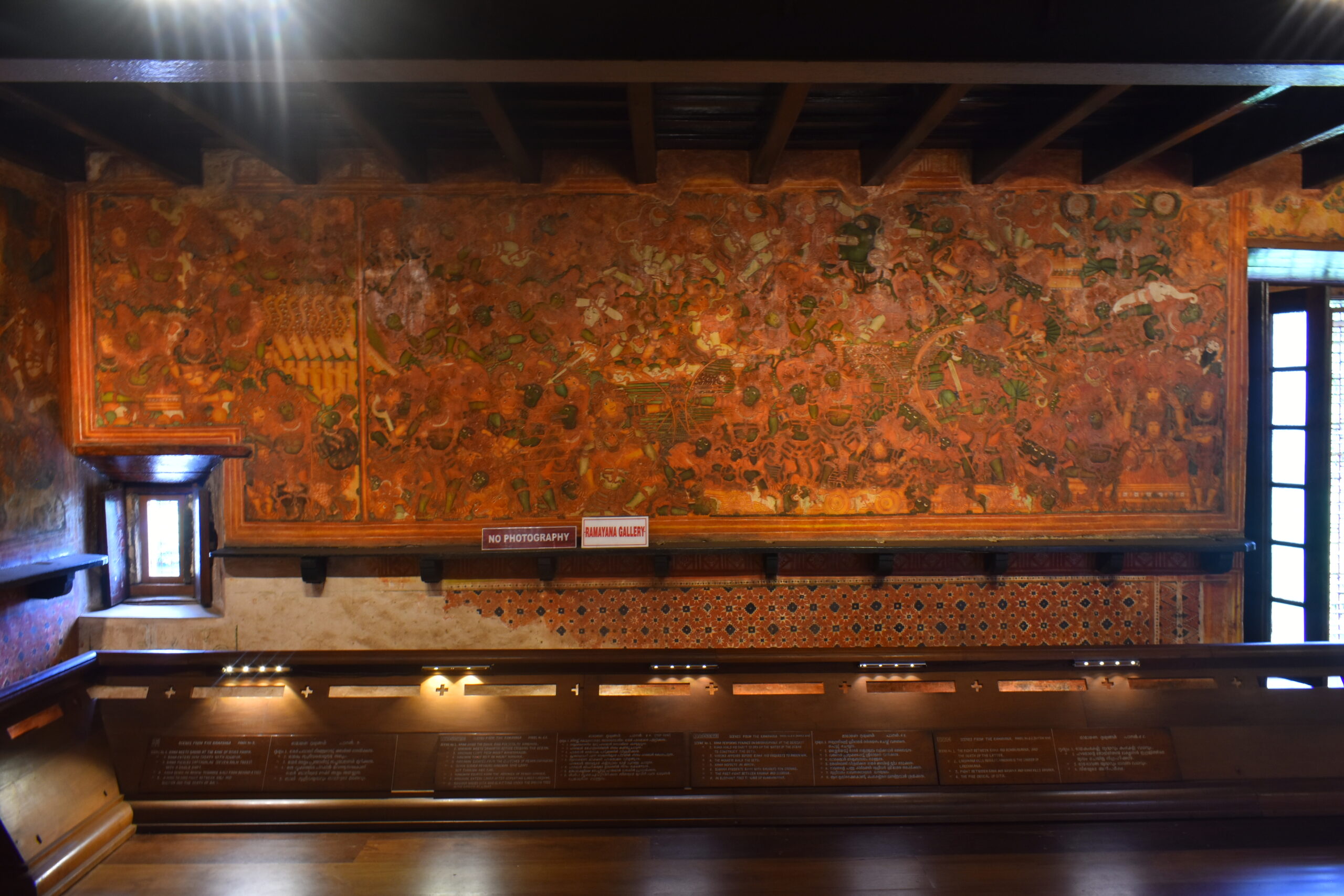
Ramayana Gallery of Mattancherry Dutch Palace
The Rules of Space
Where each emotion was permitted to appear
The ancient treatises — the Chitrasoothra and Chitralakshana — did not merely specify how to paint. They specified where. The rasas, or emotional registers, that a mural could express were prescribed according to the type of space in which it appeared. This was not aesthetic preference. It was architectural theology.
| Space | Rasas permitted | Notes |
|---|---|---|
| Temple | All rasas | Including karuna (suffering, war, death, cemetery scenes) — the full range of the tradition's emotional vocabulary |
| Palace assembly hall | All rasas | Public halls could hold the full program; karuna scenes were permitted here as they were in temples |
| Palace private chambers | Hasya Sringara Shanta | Humour, love, and peace — scenes of war, death, or intense suffering were excluded from private residential spaces |
| Private home | Hasya Sringara Shanta | The most restricted context; the Chitrasutra warns artists against even decorating their own homes themselves |
This spatial distribution of emotional registers meant that the palace was a site of genuine artistic range — capable of holding both the solemnity of the mythological program and the lightness of hasya and sringara. Depictions of historical figures, of the wayward life of the ruling class, of poverty and disease (rendered subtly), and of royal portraiture alongside divine narratives — all of this was possible within the palace context in ways that the purely ritual logic of the temple did not accommodate.
Historical figures from Kerala's own court life appear in palace murals: Shankaracharya, Swathi Thirunal, rulers of the Thiruvithamkoor line. The tradition, which in temples maintained a strict focus on mythological programs, here opened to the documentary. The divine and the historical shared the same wall.
The Sites
Four palaces, four distinct programs
The surviving palace mural tradition is concentrated in a small number of sites, each with its own architectural character and mural program. Together they constitute a cross-section of the tradition's range — from the complete Ramayana cycle at Mattancherry to the monumental Gajendra Moksham panel at Krishnapuram.
Kochi · ASI Protected
Mattancherry Palace
Built by the Portuguese, presented to the Raja of Cochin, later renovated by the Dutch — the palace that carries its political history in its name also carries the most complete surviving palace mural program in Kerala. The Ramayana cycle covers all four walls of the royal bedchamber; additional programs appear in the chambers surrounding it.
Ramayana cycle Post-primary eraKayamkulam · Travancore
Krishnapuram Palace
Houses the largest single Kerala mural in existence — the Gajendra Moksham panel, approximately 14 by 10 feet, depicting Vishnu's rescue of the elephant king. The Narasimha killing Hiranyakashipu panel here is noted for its close resemblance to the Kathakali makeup of Narasimha.
Gajendra Moksham Travancore patronagePadmanabhapuram · Travancore
Padmanabhapuram Palace
The female figures in the mural program here represent the Shankhini type — characterised by long face structures and firmer bodies — as identified by Sasibhooshan (1994). The contrast with the Padmini figures at Mattancherry reveals how the tradition varied not just in theme but in figurative canon across sites.
Shankhini figure type Middle eraThrippunithura · Central Kerala
Thrippunithura Dutch Palace
A privately held property with access granted at the owners' discretion. The mural program here is unlike any other Kerala palace site — colonial figures, British men and women, royal portraits, and floral decorative borders painted in the same Kerala mural tradition. The owners have requested that no images be published; the archive respects this restriction and holds documentation for internal research use only.
Colonial-era subjects Private access onlyThe Spatial Narrative
Moving through rooms, moving through the Ramayana
The mural program at Mattancherry Palace is not a collection of images. It is an architecturally integrated narrative system — the Ramayana distributed across the walls of multiple chambers, its story unfolding spatially as the viewer moves through the sequence of rooms.
The viewer who moves through these chambers in order encounters the Ramayana as a spatially distributed story — one that unfolds through architectural movement in a manner that mirrors the temporal unfolding of the epic itself. Bharata, Lakshmana, and Shatrughna in the coronation panel stand with stances that Vatsyayan (1989) describes as appearing to have been lifted from Kathakali — "complete with taut, erect torsos and stylized standing positions." The costumes and headgear of the figures match their Kathakali counterparts closely enough that Vatsyayan notes they might be photographs of Kathakali characters, "except for the absence of the Kathakali upper jacket."
— Thesis, Chapter 4
This spatial quality is what individual image extraction cannot preserve. A panel from the Mattancherry Ramayana, removed from its position in the room sequence and presented as a discrete image — in a catalogue, a digital archive, or a photograph — loses the relational meaning that its position within the larger program provides. The figure makes sense iconographically. It does not make sense narratively without its neighbours on the adjacent walls and in the adjacent rooms.
This is a central problem the Kerala Mural Archive was designed to address: how to make the spatial, sequential, and narrative relationships between panels legible within a digital interface, without claiming to simulate the embodied experience of moving through the palace itself.
The Female Figure
Shankhini and Padmini — two canons across two sites
The ancient texts describe multiple canonical types for the female figure in mural painting. Two are identifiable across Kerala's surviving palace sites in ways that reveal how the same tradition produced distinct visual registers at different courts.
Type I
Shankhini
Padmanabhapuram Palace · Travancore
Type II
Padmini
Mattancherry Palace · Cochin
These are not simply stylistic variations between individual artists. They reflect how two different royal courts — Travancore and Cochin — interpreted the same iconographic canon and produced distinct visual cultures within a shared tradition. The same dhyana sloka, recited by a painter at Padmanabhapuram and a painter at Mattancherry, yielded different figures on the wall. The tradition was consistent in its rules and variable in its results.
The Colonial Turn
British men and women on a Kerala mural wall
The program at Thrippunithura Dutch Palace represents the tradition's most striking encounter with the colonial world. Where Mattancherry and Padmanabhapuram depict mythological programs — the gods, the epics, the devotional figures of a thousand-year iconographic canon — Thrippunithura's walls carry colonial figures: British men and women, royal portraits from the era of contact between Kerala's ruling houses and the East India Company, floral borders running between them in the same style that separated scenes of divine narrative in earlier palace programs.
The painters who worked here were trained in exactly the same tradition as those who painted the Ramayana at Mattancherry. The pigments, the lime plaster ground, the compositional conventions — all the same. What changed was the subject matter. And the subject matter records, in the medium of Kerala's own artistic tradition, the political realities of the period in which these walls were painted.
This is also a site that cannot be shown. The property is privately held, and the owners — who granted the archive access for documentation — have requested that no images be published, citing their privacy. The archive holds this documentation in its internal research record. The restriction is respected without qualification.
A tradition that began painting the gods of the Hindu pantheon on temple sanctum walls, and ended painting British colonial figures on palace walls — in the same pigments, on the same lime plaster, by artists trained in the same lineage — contains within itself the full arc of Kerala's encounter with colonial modernity. Thrippunithura is where that arc is most visible. It is also, for now, where the public record stops.
The Problem of Documentation
What the archive can and cannot preserve
Palace murals present a distinctive set of challenges for digital documentation. Unlike temple murals, which are embedded within active ritual contexts and encountered through circumambulatory movement, palace murals occupy spaces now accessible to visitors moving in any direction, at any pace, without ritual structure.
Mattancherry Palace, under ASI protection, was documented under conditions stipulating scholarly non-commercial use. Thrippunithura Dutch Palace is privately held — access was granted by the owners on the explicit condition that no images be published, a boundary the archive observes. The documentation exists in the archive's research record; it does not appear in its public interface. That restriction is, itself, part of the archive's record: a reminder that access is always conditional, and that the most significant sites are sometimes the ones the public cannot see.
The Ramayana at Mattancherry unfolds through rooms. The archive presents it through panels. Something is preserved; something is lost. The archive's task is to be honest about both.