Kerala Mural Archive · Contexts
What the Wall Borrowed
Influences on Kerala Mural Painting
No tradition exists in isolation. Kerala mural painting absorbed from the arts that surrounded it — from theatre, from sculpture, from textile, from manuscript illustration. These influences moved in multiple directions and across centuries. Tracing them changes what you see when you stand before the walls.
Theatre
Kathakali
Costumes, headgear, postures, and mudras from Kerala's classical dance-drama appear directly in the mural figures.
Sculpture
The thala system
Proportional canons from temple sculpture governed how figures were measured and composed — though mural painters applied them with more freedom.
Manuscripts
Palm-leaf illustration
The same iconographic types and colour conventions moved between illustrated manuscripts and walls — the portable grammar of the page brought to permanent stone.
Regional life
Kerala's living world
Local instruments, Namboothiri figures, historical personalities, and even scenes of poverty appear within the mythological compositions on the walls.
The Theatre Connection
Kathakali on the wall
The relationship between Kerala murals and Kathakali — Kerala's classical dance-drama — is visible to anyone who looks carefully. The costumes, the headgear, the stylised standing positions, the taut erect torsos of figures in the murals: these are the postures and ornamentations of Kathakali performers.
Kapila Vatsyayan observed that the paintings are the pictorial counterparts of Kerala's highly developed dramatic art, inseparable from the theatrical experience. Looking at the Ramayana murals at Mattancherry and Thiruvanchikkulam, Bharata, Lakshmana, and Shatrughna in the panel of Rama's coronation appear to have been lifted directly out of Kathakali — complete with taut, erect torsos and stylised standing positions.
M.G. Sasibhooshan identifies the common dance mudras and postures that appear throughout the murals. The preference for tribhanga — the triple-bend stance — is especially strong, mirroring classical Indian sculpture and dance simultaneously.
Mudras found across the murals:
Postures:
The Narasimha panel at Krishnapuram Palace resembles the makeup of Narasimha as he appears in a Kathakali performance so closely that the theatrical influence appears direct. The costumes and headgear of figures in the Mattancherry Ramayana correspond closely to Kathakali versions of the same mythological figures.
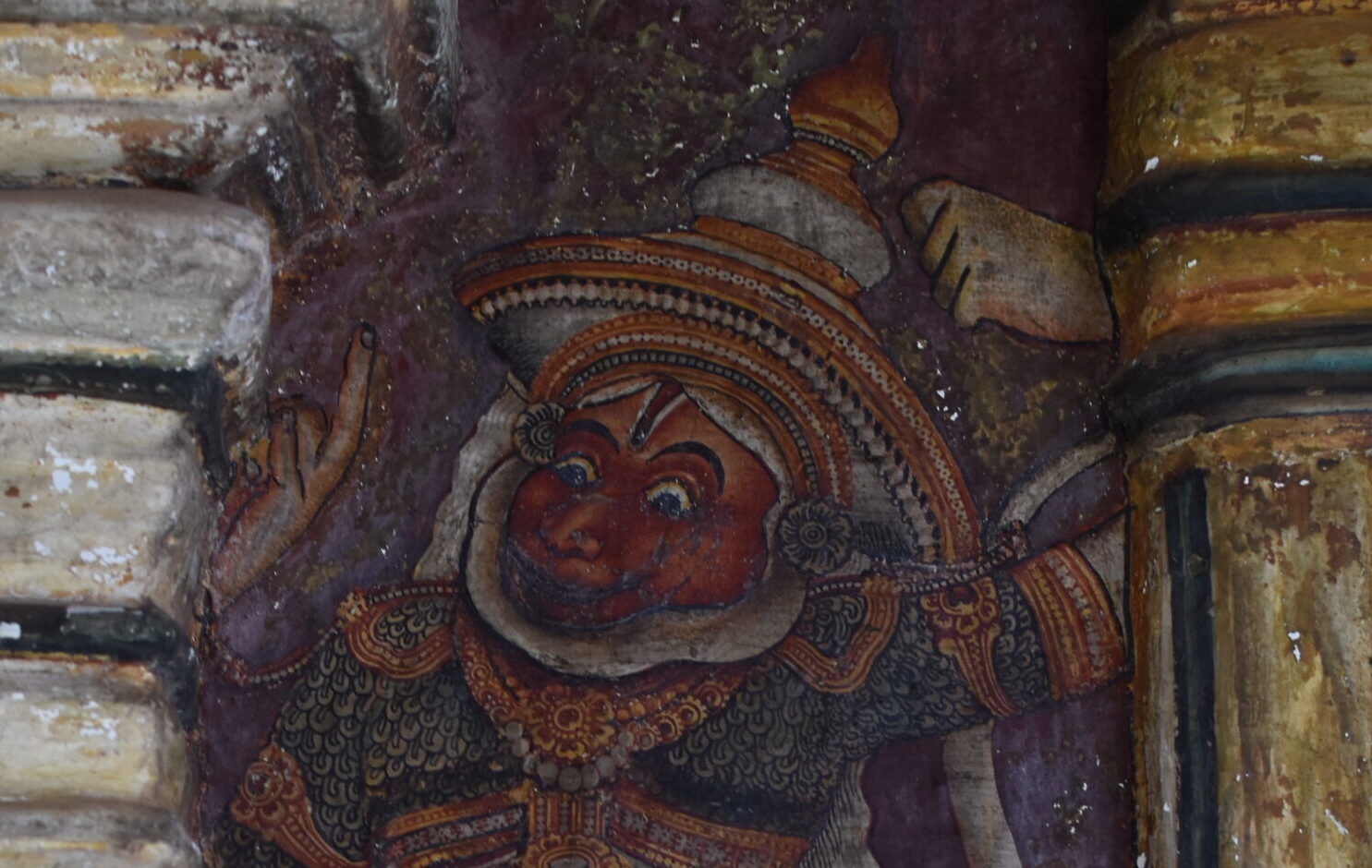
Image of Hanuman with headgear and ornamentations resembling vellathadi of Kadhakali, Peruvanam Mahadeva Temple.
The Body System
The thala — measuring the divine form
The influence of sculpture on Kerala mural painting operates through the thala system — the proportional measurement framework governing how figures are drawn. A thala is roughly the length of a palm, divided into twelve angulas. Different thalapramanas apply to different deities, sometimes depending on context.
Though mural artists employed thala pramanas, they were less strict about them than sculptors. The murals gave the painters more interpretive freedom — and that freedom is visible in the variation between depictions of the same deity across different sites. Different artists visualised the same god differently, even while working from the same dhyana sloka.
The compositional source. Dhyana slokas from texts including Prapanchasaram, Sharadathilakam, and Manthramahadathi were the painter's primary reference — Sanskrit verses describing the deity's appearance, attributes, and posture. Not direct observation of the world, but meditative visualisation guided by scripture.
The Manuscript Tradition
The portable grammar of the page
Kerala's manuscript illustration tradition — palm leaf manuscripts with illustrated margins and covers — shares visual vocabulary with the mural tradition: the same iconographic types, the same colour conventions, the same approach to depicting multiple narrative moments within a single frame.
The manuscript tradition made the visual grammar mobile — transmissible, reproducible, portable — in ways that wall painting could not be. It is likely that painters consulted illustrated manuscripts as compositional references, bringing the portable grammar of the page to the permanent grammar of the wall.
Local Life on the Wall
Kerala's world within the mythological frame
Beyond the formal artistic influences, Kerala's regional life appears throughout the murals in ways that are sometimes surprising. Local musical instruments appear in the hands of figures who in textual sources carry different objects.
Namboothiri men and women are depicted alongside mythological figures. Historical figures including Shankaracharya, Swathi Thirunal, and kings of Thiruvithamkoor make appearances. Some painters even depicted poverty, disease, and the wayward behaviour of the ruling class — subtly, within the margins of mythological scenes. The wall was not only theological. It was also observational.
Two distinct types of female figure can be identified across the murals:
Shankhinis
Padminis
These distinctions follow textual prescriptions, but they also reflect regional aesthetic preferences that the painters embedded in the tradition across different sites and patronage contexts.
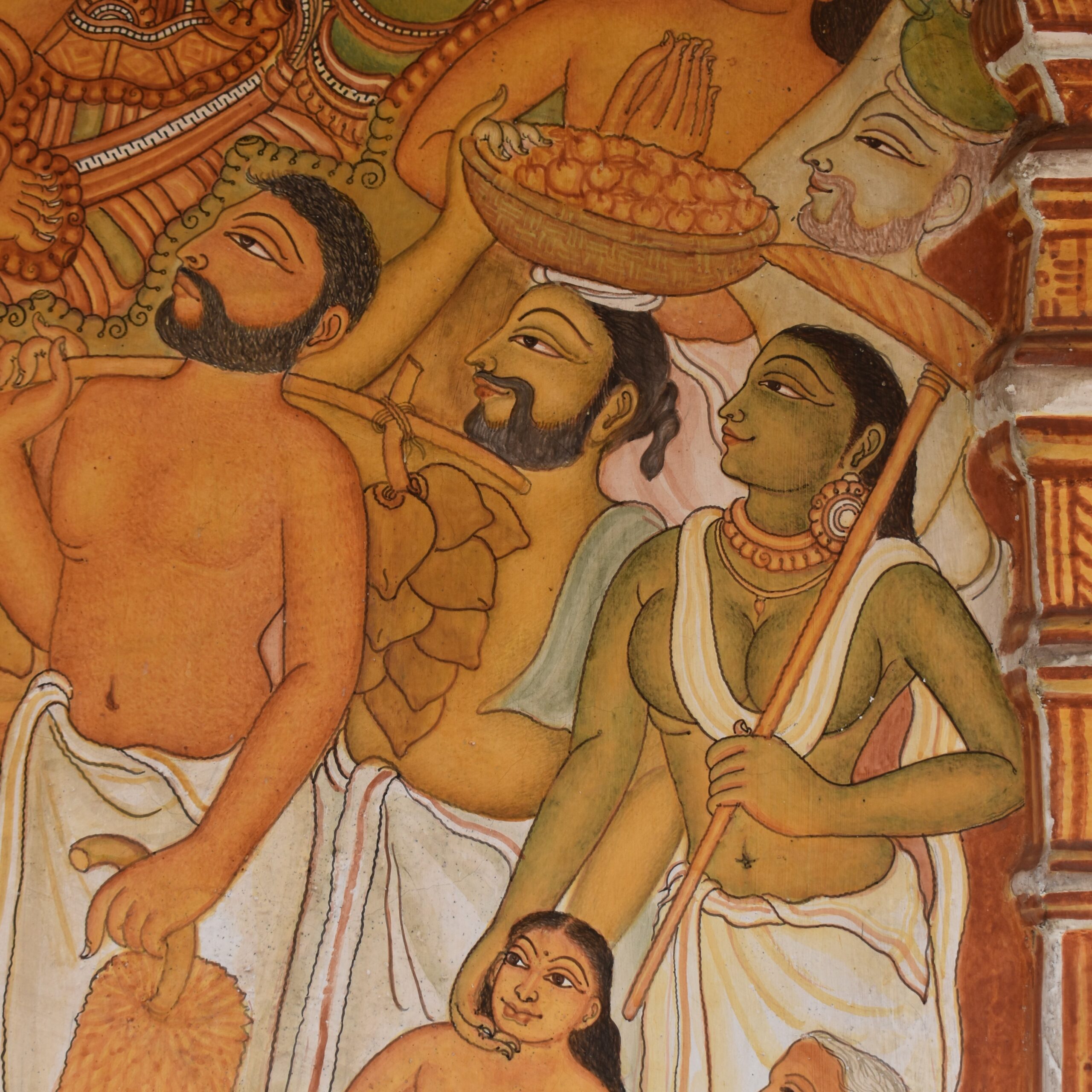
People with offerings regional life depicted within a mythological scene, Image from Thalore Mahadeva Temple.
The Modern Disruption
Contraction, revival, and expansion
The twentieth century introduced a different set of influences. With the onset of British rule, European painting styles began entering Indian artistic consciousness.
19th–20th century
The Raja Ravi Varma disruption
The popularity of Raja Ravi Varma led many artists to abandon the Kerala mural tradition in favour of his naturalistic, oil-based style. The tradition contracted significantly over several decades.
1970s
The Guruvayur fire
Fire at Guruvayur temple destroyed the murals there. The loss prompted recognition of what was at stake — and laid the groundwork for institutional revival.
1989
Guruvayur Devaswom Mural Institute
A centre for studying and promoting murals established in Guruvayur under the Devaswom administration — the first formal institution dedicated to the tradition's preservation.
1990
Mural camps
Mural camps organised by the Thanjavore-based Southzone Cultural Centre, bringing practitioners and students together in concentrated study of the tradition.
Present
Four teaching centres
Guruvayur Devaswom Mural Institute · Ernakulam Ravipuram Indian School of Arts · Kalady Sree Sankaracharya University · Aranmula Vasthuvidya Kendra
The Tradition Today
The second-generation mural artists work in a different world from their predecessors — increasingly using online spaces, social media, e-commerce sites, and YouTube to disseminate their work. The murals appear in new forms: as decorative pieces, as part of textiles, on the interiors of hotels and commercial spaces. The tradition has broken out of its constrained reverence.
Whether this expansion represents vitality or dilution — or both simultaneously — is one of the questions this archive sits inside.